The Ecclesial Deficit: Liturgical Narcissism and the Loss of Catholic Identity

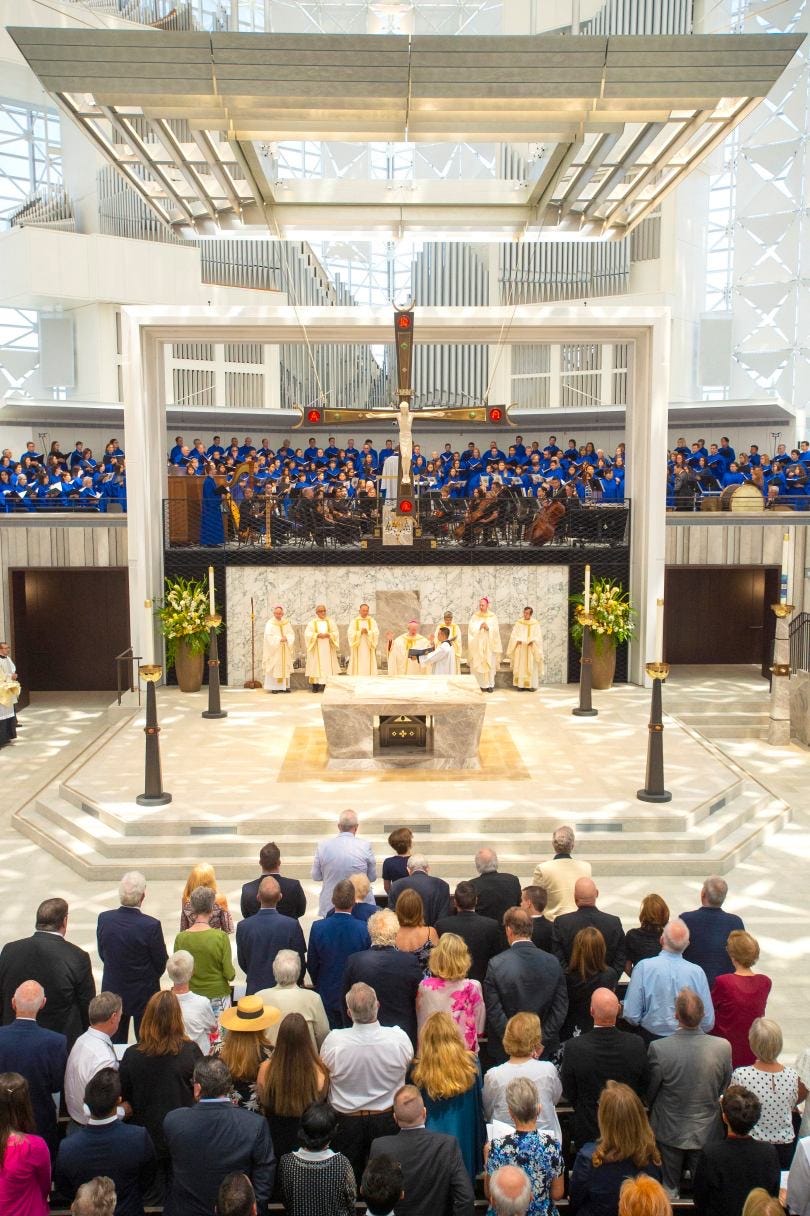
Dedication of Christ Cathedral in the Diocese of Orange, a marvelous celebration of the Church as “We!”
During my active teaching days, I would often make a distinction between “Me and Jesus” Catholics and “We and Jesus” Catholics. Me and Jesus Catholics have been overly influenced by Protestant evangelicals who continually laud the importance of a personal relationship with Jesus.
Don’t get me wrong—a personal relationship with the Lord is the foundation of our faith. However, we Catholics and many other Christians of liturgical churches don’t stop there. That personal relationship goes on to be celebrated and enriched as a We and Jesus relationship within the communion of the Church.
This progression of conversion moves from non-belief to belief in God (theistic); from a belief in God to a belief in Jesus as Lord and Savior (Christic); and finally, taking that personal belief in Jesus and celebrating it in the midst of the community of the Church (ecclesial). The great Jesuit theologian Bernard Lonergan explored similar dynamics in his work on conversion, recognizing that authentic faith must move through religious, moral, and intellectual dimensions—all of which find their fullest expression not in isolation but within the Body of Christ.
The Foundation: Pius XII’s Mystici Corporis
It was Pope Pius XII who gave the Church one of the twentieth century’s greatest rediscoveries: the understanding of the Church as the Mystical Body of Christ. His 1943 encyclical Mystici Corporis Christi represented a profound theological ressourcement, recovering the Pauline vision that had been somewhat obscured in the centuries of Counter-Reformation apologetics that emphasized the Church’s institutional and hierarchical dimensions.
Pius XII wrote with clarity about our intimate union with Christ and with one another:
“For though the juridical principles, on which the Church rests and is established, derive from the divine constitution given it by Christ and contribute to the attaining of its supernatural end, nevertheless that which lifts the Society of Christians far above the whole natural order is the Spirit of our Redeemer who penetrates and fills every part of the Church’s being and is active within it until the end of time as the source of every grace and every gift and every miraculous power.”
This was not mere theological speculation. Pius XII was recovering the biblical and patristic understanding that we are not simply individuals who happen to belong to an organization called the Church. Rather, we are members of Christ’s Body, organically united to Him and to one another through baptism. As Paul writes, “Now you are the body of Christ and individually members of it” (1 Cor 12:27).
From Mystical Body to Liturgical Expression
It was this ecclesial recapturing of the Body of Christ that laid the foundation for Pius XII’s great encyclical on the sacred liturgy, Mediator Dei (1947). This document was a direct precursor to the Second Vatican Council’s reform of the sacred liturgy in Sacrosanctum Concilium.
In Mediator Dei, Pius XII made explicit the connection between our identity as the Body of Christ and our liturgical celebration:
“The sacred liturgy is, consequently, the public worship which our Redeemer as Head of the Church renders to the Father, as well as the worship which the community of the faithful renders to its Founder, and through Him to the heavenly Father. It is, in short, the worship rendered by the Mystical Body of Christ in the entirety of its Head and members.”
Here is the crucial point: the liturgy is not the prayer of isolated individuals who happen to be in the same building at the same time. It is the prayer of the Body. When we celebrate the Eucharist, we do not come as solitary souls seeking a private audience with the divine. We come as members of Christ’s Body, and our prayer is the prayer of the whole Church—united with the saints, with the universal Church across the world, with those who have gone before us and those who will come after us.
The Language of Ecclesial Identity
The language of that expression is liturgical. The liturgy is how the Church speaks, how the Body of Christ prays, how we express our identity as a communion of believers. This is why the liturgical reforms of Vatican II were fundamentally about recovering the communal, ecclesial nature of our worship. Sacrosanctum Concilium called for “full, conscious, and active participation” not because the Council fathers wanted to make Mass more entertaining or accessible, but because they understood that the liturgy is the action of the whole Body of Christ, not a clerical performance observed by a passive audience.
When we speak of liturgical language, we are not merely talking about whether Mass is celebrated in Latin or the vernacular, or whether the priest faces east or west. We are talking about the fundamental grammar of Catholic identity: that we are a “we” before we are a “me.” The liturgy teaches us this grammar through its very structure—we pray together, we respond together, we receive together, we are sent forth together.
The Narcissistic Regression
Sadly, the liturgy wars of recent decades point to a dangerous regression—an almost obsessive return to a narcissistic understanding of our relationship with God and His Christ. Rather than embracing our identity as the Body of Christ expressed through the Church’s liturgy, we witness an alarming individualism that reduces faith to “Me and Jesus” spirituality.
This liturgical narcissism manifests itself in countless ways, but the pattern is consistent: my preferences, my spiritual needs, my understanding of tradition trump the communal, ecclesial nature of Catholic worship. Consider these examples:
In Liturgical Practice: A parishioner declares, “I don’t care what the norm for Communion is, I’m going to kneel”—making a unilateral decision that centers their personal piety over the communal action of the assembly and the pastoral judgment of the Church. Or consider those who insist, “I don’t care what the Council and Pope say about the reformed liturgy, I’m going to worship with the old Mass and nobody can tell me otherwise”—as if the liturgy were personal property rather than the prayer of the whole Church.
In Priestly Ministry: A priest announces, “I like celebrating Mass ad orientem and I really don’t care what my congregation may say or feel”—substituting his liturgical aesthetics for pastoral sensitivity to the community he serves. The liturgy becomes about his preferences, his formation, his sense of what is beautiful, rather than the prayer of the Body of Christ entrusted to his care.
Even more troubling is the case of a priest member of a large religious community who insists on privately celebrating the Eucharist rather than concelebrating with his brothers so that he can celebrate "my Mass," celebrate in the usus antiquior, or pursue the theologically dubious notion that "more Masses, more graces!" While he may technically comply with the letter of the law by securing a server for his celebration, this represents a profound failure to grasp the ecclesial nature of the liturgy. Sacrosanctum Concilium is explicit: “Whenever rites, according to their specific nature, make provision for communal celebration involving the presence and active participation of the faithful, this way of celebrating them is to be preferred, so far as possible, to a celebration that is individual and quasi-private” (SC 27). The General Instruction of the Roman Missal reinforces this principle, stating that Mass “should not be celebrated without a minister or at least one of the faithful, except for a just and reasonable cause” (GIRM 254). The preference for a particular ritual form over communal celebration with one’s own religious community—even when given a grudging and thin veneer of canonical acceptability—reveals a “Me and Jesus” spirituality that has tragically eclipsed the “We and Jesus” reality of the Body of Christ.
In Sacramental Preparation: Parents demand that their child’s First Communion be scheduled at their personal convenience, disrupting the parish’s communal celebration and treating the sacrament as a private family event rather than the child’s initiation into the eucharistic life of the Church.
In Theological Stance: Catholics selectively accept only the Church teachings that align with their pre-existing worldview—whether progressive or traditionalist—and publicly dissent from magisterial authority, effectively declaring, “My discernment of truth is more reliable than the Church’s, so I’m free to create my own Catholicism.”
Each of these examples, seemingly small in isolation, represents a fundamental failure of ecclesial conversion. They reveal Catholics who have completed the theistic journey (they believe in God) and perhaps even the Christic journey (they have a personal relationship with Jesus), but who have failed to make the essential ecclesial conversion—the recognition that their faith must be lived and celebrated within the communion of the Church, the Body of Christ.
The Need for Ecclesial Reconversion
What we desperately need is a reconversion to an ecclesial identity. This truly represents what it means to be “Catholic”—from the Greek katholikos, meaning “whole” or “universal.” To be Catholic is to be part of something larger than ourselves, to locate our identity not in our individual spiritual journey but in the communion of the Church.
Ecclesial conversion is at the heart of what it means to be Catholic. It means recognizing that the Church is not simply a service provider for my spiritual needs, a vendor of sacraments, or a voluntary association of like-minded believers. The Church is the Body of Christ, and I am a member of that Body. My relationship with Christ is inseparable from my relationship with His Body. My prayer is the Church’s prayer. My faith is the Church’s faith. My worship is the Church’s worship.
This is why liturgical narcissism is so dangerous. It represents not merely poor pastoral practice or unfortunate aesthetic choices. It represents a fundamental failure to grasp our Catholic identity. When we reduce the liturgy to personal preference, when we treat the Church’s worship as something to be customized according to individual taste, when we substitute “Me and Jesus” for “We and Jesus,” we are not simply being difficult parishioners—we are abandoning the very heart of what makes us Catholic.
The Second Vatican Council understood this. Lumen Gentium recovered Pius XII’s vision of the Church as the Mystical Body of Christ and deepened it with the biblical image of the People of God. Sacrosanctum Concilium called us to liturgical reform precisely because authentic liturgy forms us as the Body of Christ, teaching us through ritual and symbol that we belong to one another, that we pray as one, that we are saved not as isolated individuals but as a people.
Conclusion: Recovering the “We”
The cancer of ecclesial narcissism—or perhaps more charitably, the danger of ecclesial narcissism—threatens to hollow out Catholic identity from within. When “Me and Jesus” replaces “We and Jesus,” when personal preference trumps communal celebration, when individual discernment supersedes ecclesial authority, we lose what makes us distinctively Catholic.
The remedy is not a return to clericalism or an authoritarian suppression of legitimate questions and concerns. Rather, the remedy is a genuine ecclesial conversion—a recognition that our identity as Catholics is fundamentally communal, that the Church is not an obstacle to our relationship with Christ but the very Body of Christ Himself, and that the liturgy is not a consumer experience to be tailored to individual taste but the prayer of the whole Church in which we are privileged to participate.
We need to recover Pius XII’s vision of the Mystical Body, Vatican II’s call to full and active participation in the liturgy, and the fundamental Catholic understanding that we are saved as a people, we worship as a people, and we are called to holiness as a people. Only then can we move beyond the sterile liturgy wars and the narcissistic individualism that plagues contemporary Catholicism. Only then can we truly be what we are called to be: the Body of Christ, united in worship, united in faith, united in love.
Monsignor Arthur Holquin, S.T.L., is a retired priest of the Diocese of Orange and retired rector of Mission Basilica San Juan Capistrano. He publishes Liturgy and Truth on Substack.
A really good read Msgr. It has gotten me reflecting along multiple different lines.
First, is on the ongoing liturgical conflict and how it has influenced me towards sin. I find worryingly an elitist and judgemental attitude and thoughts coming to me during the mass, when other parishioners "stray" from the GIRM. Part of this built up because I am a convert so I had to study what to do in the mass, but part of it is a holier than thou judgment and projection of my own feelings.
So when I see my fellow parishioners do things that I wouldn't do, I try to find the good in what they are doing. When I see more traditional practices I need to remind myself that they do it out of reverence and love. And when I see more liberal practices I remind myself that they are either A. Volunteering to serve the church, a good and holy act. B. That it may be how they were taught. C. I don't actually know what is going on in their day and maybe just showing up is a great triumph that the angels will celebrate.
I am reminded of a Sunday where the piano player was quite clearly a beginner and to be frank not very good. And yet here she was trying her best to offer praise to God and offering up her time and potential embarrassment to serve. Which was more than I was doing since I have left my piano skills atrophy.
The second line of thinking is your point on pulling from Evangelical Protestants. As a convert from that movement I hope to offer some thoughts on We and Jesus.
Your point on an over emphasis on personal relationships certainly rings true. It troubles me when I see practices like church shopping follow me to Catholicism. I have seen and heard of various protestant communities ripped apart by secondary concerns like music, or language used. You will also often see people shop around to find which church will suit their exact desires as that is where they feel “closest” to God.
That being said, any former evangelical will probably say one of the biggest culture shocks to becoming catholic is the lack of fellowship before and after the mass. It was very strange going from 50% of parishioners sticking around after for coffee and small talk, and monthly potlucks. To virtually everyone leaving right afterwards with maybe a community meal 4 times a year. It can leave a convert a bit lonely while they integrate into the Catholic community.
Sorry for a bit of a long rambling reply just lots of thoughts. I hope your Pascal season goes well. God Bless.
I was in mass once, and the priest told us all to stand and look our neighbor in the eye. "That," he said, "is the face of Christ." Unless the liturgy brings us there, I'm not sure what it's doing.