The Whole Diamond
On priests who pray only the Roman Canon — and what that choice quietly teaches

A word before I begin. Liturgical theology is my first love — the slow unfolding of our rites across the centuries, and the faith those rites carry and hand on. What follows is more particular, and more clerical, than my usual fare: it concerns a habit I have noticed among some of our younger priests, and it ventures into the history and structure of the Eucharistic Prayers. Those of you who are not priests are most welcome to listen in; you may find the terrain more interesting than its map suggests. But I write this one chiefly for my brothers at the altar.
A friend recently described to me a young priest, who has never once in his priesthood prayed a Eucharistic Prayer other than the Roman Canon (Eucharistic Prayer I). Not on a Tuesday in Ordinary Time. Not at a funeral. Not at a school Mass. When asked about it, he answered pleasantly enough that he preferred to pray “the one the Church actually prayed for fifteen hundred years.”
I do not doubt his sincerity. I want to take his answer seriously, because it is not really an answer about preference at all. It is a theological claim, and it is being taught — silently, weekly, to people who will never read a word of liturgical scholarship — from the center of the sanctuary.
The claim is this: that among the anaphoras or Eucharistic Prayers of the reformed Roman Missal, one is safe and the rest are, at best, tolerable. That the Church, having set a whole range of Eucharistic Prayers before her priests, provided a single one of genuine orthodoxy and left the remainder in various states of doctrinal thinness, and that the discerning presbyter will quietly select the first and let the others gather dust. It is never stated. It does not need to be. A congregation that hears one anaphora and only one for a decade will draw the obvious inference about the rest.
I want to say plainly that this is bad history, weak theology, and — the point that concerns me most — a failure of ministerial charity.
What the Canon’s defenders concede
Begin with the history, because it is not what these priests have been told.
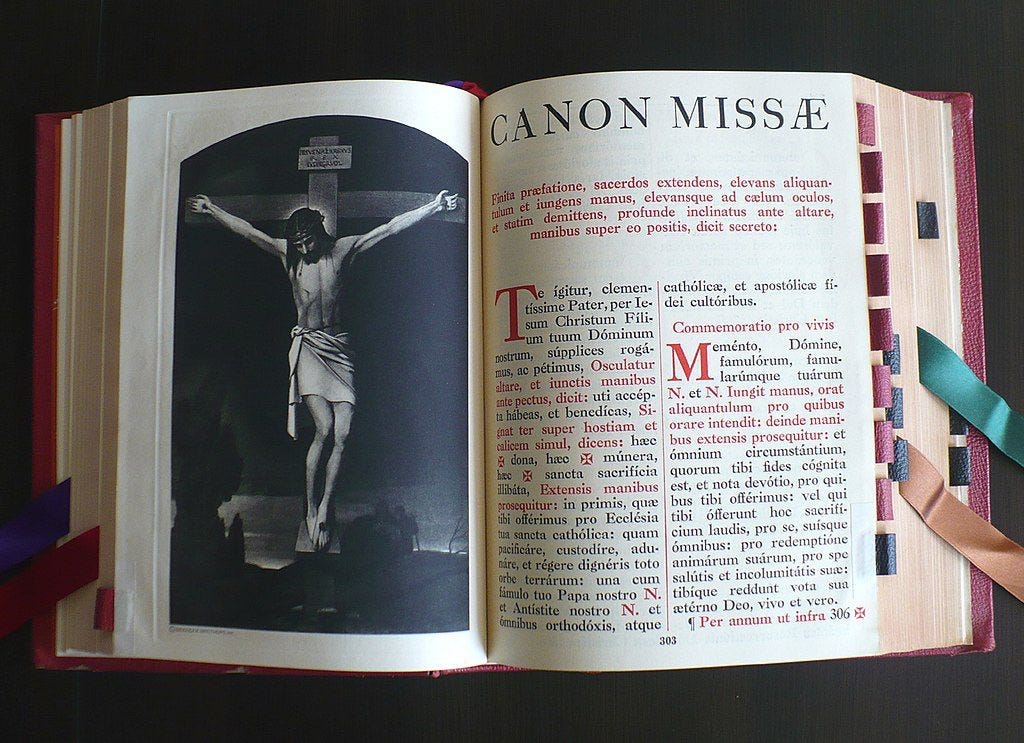
The critique of the Roman Canon is not a product of the post Vatican II Consilium. It is considerably older, and it was voiced by men who loved the Canon. The Fathers of Trent themselves put certain of its features under review — the sacrificial vocabulary anticipated in the Offertory, the crosses traced over the already-consecrated elements. The great liturgical scholar, Josef Jungmann, no revolutionary, wrote of the Canon that abbreviations and displacements had disturbed its continuous unity, and compared the Mass-liturgy to a venerable castle whose crooked corridors and narrow stairways strike the visitor at first as strange. The British liturgical scholar, Adrian Fortescue, writing in 1912, could not determine what the Te igitur that begins the Canon is meant to refer back to.
When Cipriano Vagaggini published Il canone della messa e la riforma liturgica in 1966, he was making an argument, and it deserves to be met as an argument. His catalogue of defects was long: no clear invocation of the Holy Spirit, an intercessory structure that reads as a series of juxtaposed prayers rather than a single movement, no depiction of salvation history, little eschatological horizon, considerable duplication. Josef Jungmann answered him in Liturgisches Jahrbuch the following year, and answered him well: Vagaggini, a systematic theologian, was imposing a preconceived structure upon a text that had grown up long before that structure was conceived, and what emerged was in good measure the author’s personal theology rather than the Church’s.
I record Jungmann’s rejoinder deliberately, because I do not want the theology of the Canon so easily dismissed. It is a magnificent and venerable prayer. But notice what neither man disputed: that the Canon has features which a fair reader will find difficult, and that a text prayed aloud in a living language presents problems that the same text, murmured in Latin behind a rood screen, never had to answer for.
Cardinal Lercaro put precisely this to Paul VI on 20 June 1966. Revision of so venerable a text, he wrote, is dangerous; but so is leaving it as it stands, since prayed aloud and unvarying it will become burdensome. His proposal — and it is the origin of everything that followed — was to leave the traditional Canon untouched and compose alternatives beside it.
Paul VI agreed, and his decision was terse: the received anaphora was to stand; two or three others were to be composed or sought out. Let that be understood clearly. Eucharistic Prayers II, III, and IV exist because Paul VI would not permit the Roman Canon to be recast. They are not its replacement. They are the price of its preservation.
Nor were they produced carelessly. The Synod of Bishops voted on the question in October 1967 and approved it by a large majority. The Congregation for the Doctrine of the Faith reviewed the drafts and rejected the Alexandrian anaphora of St Basil over a difficulty with its epiclesis - the invocation of the Holy Spirit on the bread and wine. Whatever else one wishes to allege about those years, the claim that the new anaphoras escaped doctrinal scrutiny is simply false.
The epiclesis, stated fairly
Here I want to be more careful than the polemics on either side usually are.
It is sometimes said that the Roman Canon has no epiclesis (The Greek word for the invocation of the Holy Spirit on the gifts of bread and wine). That overstates. The Quam oblationem petitions the Father to make the offering blessed, approved, ratified — a consecratory petition in the epicletic position. The Supplices te rogamus asks that the offering be borne to the altar on high — an oblationary petition after the institution narrative. Structurally, the Canon has what an epiclesis does. What it lacks is any specific invocation of the Holy Spirit.
And this is not a defect in the ordinary sense. The Roman Canon took shape before the fourth-century controversies over the divinity of the Spirit. It is Patricentric by formation, not by refusal. Its most vigorous contemporary champions concede the point and reframe it, rightly enough, as a mark of its antiquity.
But grant the concession and see where it leads. The Roman tradition, left to itself, never developed a pneumatological anaphora. The Church universal did — in Antioch, in Alexandria, in Jerusalem, in Byzantium. When the reformed Missal placed before the priest three prayers that invoke the Spirit explicitly upon the gifts and upon the assembly, the Roman Rite was not being corrected by outsiders. It was receiving, at long last, from the patrimony of the whole Church what its own history had not given it.
The young priest who prays only the Roman Canon is not defending the Roman tradition against innovation. He is confining the people entrusted to him to a Trinitarian horizon narrower than the one the Church has actually set before them.
The antiquity argument turns in the hand
There is a further difficulty with the appeal to fifteen hundred unbroken years, and it is worth naming gently.
The Canon these priests pray is not the Canon of 1570. St Joseph was inserted after the Blessed Virgin in 1962 — the first alteration to the Roman Canon in centuries, and by the hand of the very commission on which Annibale Bugnini sat. The concluding formulas of the saints’ lists were adjusted in 1969. The mysterium fidei, for centuries embedded in the words over the chalice, was lifted out and given to the people as their acclamation.
And more: it is prayed aloud, in English, in a translation of 2011, facing the people, with a memorial acclamation inserted in the middle of it and the Great Amen sung by the congregation. Every one of those is a reform of Paul VI. The Roman Canon as it is prayed in an American parish on a Sunday in 2026 is being prayed inside the architecture of the reformed rite. To pray the Canon inside the reformed rite — its translation, its posture, its acclamation, its Great Amen — and then treat the reformed anaphoras as suspect, is disingenuous.
What the law actually says
The General Instruction is not obscure on this. Eucharistic Prayer I may always be used — a permission, and a genuine mark of honour. It is especially suited to days with a proper Communicantes or Hanc igitur, to the feasts of the apostles and of the saints named within it, and to Sundays, unless pastoral reasons commend the third. The second is more appropriate to weekdays. The third is to be preferred on Sundays and festive days. The fourth, with its unchanging preface and its sweep of salvation history, is offered for Sundays in Ordinary Time.
May always be used is not should always be used, and it is certainly not only this one. The Instruction sets out a range, and the priest who collapses that range to a single point has not obeyed the norm more strictly. He has ignored it.
And the range is wider than most Catholics suppose. Ask a well-catechized parishioner how many Eucharistic Prayers the Missal contains and the answer will be four. The answer is ten.
And then there is the sentence that governs the whole chapter, which I wish were better known: in arranging the celebration of Mass, the priest is to attend to the common spiritual good of the People of God rather than to his own inclinations.
That is the law. It is also, I would suggest, the whole of the matter.
Rigidity is a personalism
Pope Francis wrote in Desiderio desideravi of inadequate ways of presiding, and listed them in opposed pairs: rigid austerity and exasperating creativity, spiritualizing mysticism and practical functionalism, sloppy carelessness and excessive finickiness. What struck me when I first read it, and strikes me still, is his diagnosis of the common root beneath these opposites — a heightened personalism of the celebrating style, sometimes concealing a desire to be the centre of attention.
We understood this readily enough when the personalism ran in the other direction. A generation of us watched priests improvise the Eucharistic Prayer, ad-lib the greeting, substitute a folk song for the Sanctus — and we said, correctly, that the Mass is not the celebrant’s property. It is the Church’s.
The same principle bears on the priest who curates the Missal for orthodoxy. He has not escaped self-referentiality by choosing the older text. He has relocated it. In both cases the presbyter has placed his own judgment above the Church’s provision and made the assembly’s prayer conform to his own conviction about what is truly orthodox. That the conviction is conservative rather than progressive alters the direction of the error, not its nature.
Pope Francis put the deeper issue exactly: the tension around the celebration is not a divergence of taste concerning ritual form. It is ecclesiological. To pray one anaphora on the ground that the others are doctrinally thin is to say that the Church, in the exercise of her supreme liturgical authority, legislated deficiently. That is a large claim. Those who make it by their practice rather than their words should be asked to make it aloud, so that it can be examined.
The fullness is distributed
Here, finally, is what I most want to say, and it is not a rebuke.
The lex orandi of the Roman Rite is not lodged in one text. It is refracted across the anaphoras as light through a cut stone, and each face throws a different colour.
The Roman Canon gives us the communion of the saints named one by one, the Church’s memory made local and particular, Abel and Abraham and Melchizedek standing in the sacrifice. The second, in its brevity, gives the Spirit descending upon the gifts like the dewfall — an image that has done more catechesis in this country than a shelf of manuals. The third identifies the sacrificial Victim by whose death the Father willed our reconciliation, and asks that we who are nourished become one body, one spirit in Christ; there is no more explicit statement of the Eucharistic sacrifice anywhere in the Roman books. The fourth unfolds the entire economy from creation to the world to come, and is the finest catechesis on salvation history the Missal contains.
And then there are the six that scarcely anyone remembers.
The two Prayers for Reconciliation were composed for the Holy Year of 1975 and authorized experimentally in 1974; their Latin text was published in 1983 for the Jubilee of the Redemption. They are prayers for a Church that must ask forgiveness rather than dispense it, and I do not know how a diocese in this country could have passed through the last quarter-century without reaching for them.
But it is the Eucharistic Prayer for Use in Masses for Various Needs that I would press most warmly on any brother priest, and its history is worth telling. It was composed at the request of the Swiss bishops for their national synod after the Council, and permission was granted in February of 1974. Because Switzerland has three languages, it was written in German, French, and Italian — that is, it was composed in the vernacular and only afterward rendered into Latin, an inversion of everything we assume about how Roman liturgical texts come to be. It was so widely requested by other conferences that the Holy See was obliged to issue an official Latin edition in 1991, drawn from the three modern-language originals, with an English translation approved in the mid-1990s and revised with the rest of the Missal.
Consider what that means. Here is an anaphora that entered the Roman Rite not by the decree of a study group but by demand — because bishops kept asking for it and the faithful kept being fed by it. It is one prayer in four strands, each with its own preface and its own set of intercessions: The Church on the Path of Unity; God Guides His Church along the Way of Salvation; Jesus, the Way to the Father; Jesus, Who Went About Doing Good. The last of these is as fine a text as the reform produced, and the priest who has never prayed it has never heard the Roman Rite speak of the Lord’s healing and his preference for the poor from within the Eucharistic Prayer itself.
Ten anaphoras, then. Benedict XVI, in Sacramentum caritatis, wrote that the Eucharistic Prayers of the Missal have been handed down by the Church’s living Tradition and are remarkable for a theological and spiritual richness that is inexhaustible — and that the faithful must be helped to appreciate that richness. It is worth dwelling on who said it. The pope most revered by the young men I am describing did not regard these prayers as a regrettable multiplication to be quietly narrowed. He regarded them as an inheritance the people have a right to, and he laid the duty of opening it to them squarely on us.
A priest who prays only one of these is not being reverent. He is being poor, and he is making his people poor with him. He has a treasury and draws on one shelf.
The presbyter is not a connoisseur, selecting from the tradition what suits his theology. He is a servant of the whole of it, and his people have a right to the whole of it. Not a scintilla of Eucharistic faith is lacking in the reformed anaphoras; but no single one of them contains the whole, and the Church knew that when she gave us all of them.
So: pray the Roman Canon. Pray it often. Pray it on the days it is proper to, and pray it slowly and beautifully and let its saints be heard. It is a magnificent inheritance and it deserves far better than the neglect into which it fell.
But pray the others too. Not as a concession. As an act of obedience, and of ministerial generosity, and of confidence that the Church who gave them to us knew what she was doing.
Monsignor Arthur Holquin, S.T.L.
Monsignor, you and I come from the same generation of seminaries and priesthood. I too fell in love with Jungmann and the "Early Liturgy." Now, 63 years ordained, 88 years young. Yes, I dabbled with made-up Eucharistic Prayers for a time, too. But, with the revisions the Church has made since Vat II and which you have so well desribed in this article, I came home to praying all ten of the current Eucharistic Prayers. Quite often, when praying one of the four for various needs, I find myself humbled by the beauty and prayerfulness of them. Thank you for your scholarly, yet pastoral, writing on so many issues. I will be ordering a copy of your first book. I too wrote one book at age 80, but it is of homilies and reflections for each day of the year. "Ad multos annos," brother priest. - Rev Denis Meier
I once met a young priest who was starting his ministry by committing to only ever praying the Roman Canon. Not a single jot or tittle was left out. When he asked me what I thought afterwards I remarked that he had demonstrated why the ancient practice of the Church had come to realise it was only fit to be said silently, so we could be sure only God had to hear it...