The Two Prides
Barack Obama opened his library this week. Donald Trump opened a different kind of book. As the Republic prepares to turn 250, two American men showed us the two things that one small word can mean.

Initium omnis peccati superbia. — “Pride is the beginning of all sin.” (Sirach 10:13)
We are in June, and the calendars and the storefronts remind us that it has become a month of pride. I will leave to others the contests over whose pride, and over what, the season has come to occasion. I want instead to recover the word itself, because it is among the most treacherous in our language—a single syllable that names, at once, the noblest and the basest movements of the human heart.
A confession before I go further, since I am about to lean on a fair amount of Latin and not all of you were subjected to it as I was. I am old enough to have had the language drilled into me in high school and then again in the seminary, back in the days when that was simply taken for granted. If I reach for it still, it is not to seem learned—heaven knows the language earns a man no credit anymore—but because there is a precision in that ancient tongue that our own does not always afford. Superbia is not quite “pride,” and pietas is not quite “piety,” and the whole of what I am trying to say lives in the gap between them.
For there are two prides, and the Christian tradition has always known it. There is the pride that is superbia, the inordinate love of one’s own excellence, which Augustine called the beginning of the fall and Thomas Aquinas named the queen and root of all the vices—the sin of the morning star who would not serve, the sin of the men at Babel who said, let us make a name for ourselves. And there is the other pride, the pride that is gratitude: the proper love a person owes to his country and his forebears, which Aquinas placed under the virtue of pietas, a part of justice, because we have received from our fathers and our nation a gift we can never fully repay, and reverence is the only honest response to a debt like that.
One pride exalts the self. The other forgets the self in thanksgiving. And in a single week this June—the week we are now within hailing distance of the Republic’s two hundred and fiftieth birthday—two men who have held the office of President of the United States offered the country a clear and almost cinematic portrait of each.
The pride that forgets itself
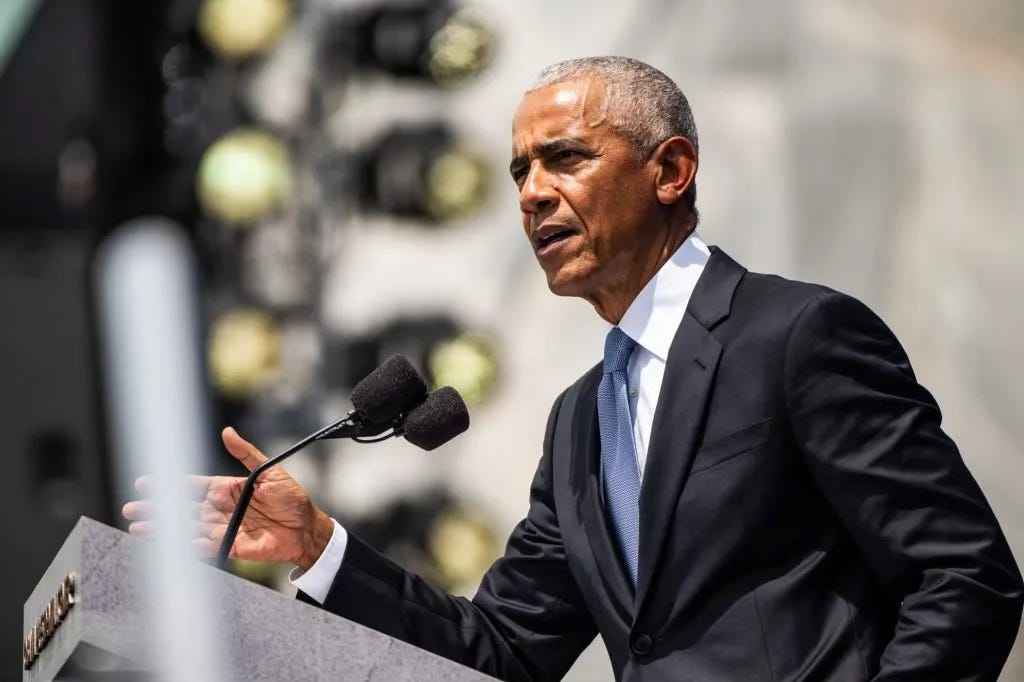
Last Thursday, on the South Side of Chicago, Barack Obama stood beneath an American flag and, flanked by three of his living predecessors from both parties, opened the presidential center that bears his name. I commend the full text to you; it repays a slow reading. What struck me, as a priest who has spent fifty-two years listening for the difference between a man performing humility and a man possessing it, was how relentlessly the address pointed away from the man delivering it.
He told visitors pressed for time to skip the clips of his own speeches—they had heard them already—and to spend their hour instead among the stories of ordinary citizens. He gestured, without flinching, at the unfinished business of his presidency and at what he called his own shortcomings and mistakes, recalling the sign he kept on the Resolute desk: Hard things are hard. He spoke of leadership as having less to do with titles or rank or the chasing of attention than with helping others find their voice. And when at last he reached for the word pride, he did not claim it for himself. He gave it away: take pride in what we accomplish together, he told the public servants in the crowd. You made that happen.
This is pride as the tradition blesses it—pride emptied of self and turned into gratitude. It is the pride of a man who knows himself to be a steward of something he did not invent and cannot keep.
And then he said the thing that makes the contrast I want to draw not my invention but his. Reflecting on the radicalism of 1776, Obama observed that until that moment human history had been, in his words, a tale of conquest and caste and rigid hierarchies—a world where the strong dominated the weak, where power and wealth and status flowed through lineage, and the many were ruled by the few. The American experiment, he said, was the refusal of all that: a nation with no kings or lords, no serfs or subjects, but only citizens. He named the convictions that make such a nation possible—the intrinsic dignity and worth of every person; that no one is above the law or beneath its protection; that the military and the law owe their allegiance not to any president or party but to the people and the Constitution; that power passes peacefully after free elections because no faction wins all the time. These, he insisted, are not Democratic or Republican values but our greatest inheritance, held no less by John McCain and Mitt Romney than by him.
Hold that picture—a nation built precisely to repudiate the rule of the strong over the weak—and turn now to the other man.
The pride that crowns itself
In the same news cycle, President Trump sat for a forty-five-minute interview with Axios and announced that, since going to war with Iran, he had discovered “no limits” to his power. That alone would be ordinary bluster. But the interview arrived alongside the disclosure, in a forthcoming book by two veteran reporters, of a document the President has been carrying and showing to visitors—a document arguing that he is more powerful than Attila the Hun, than Genghis Khan, than Napoleon, than Stalin, than Mao, than Hitler. The authors report that he read from it aloud, reciting the names of history’s great conquerors and explaining how each fell short of him. They note, chillingly, the evident pleasure he took in the company of Mao, Hitler, and Stalin, and the untroubled ease with which he accepted a place among men who reshaped the world through conquest and fear. The document’s conclusion, which the President himself posted to social media, is that he is “by far the most powerful person that has EVER walked this planet.”
Read those two speeches side by side. One man stands in a building devoted to ordinary citizens and calls the American idea a deliverance from the world of conquerors and kings. The other man privately ranks himself above the very conquerors and tyrants—Napoleon, Stalin, Mao, Hitler—whom that idea was conceived to render forever impossible on these shores. Obama measures a presidency by what we accomplished. Trump, by his own testimony to Axios, measures power by submission: the G7 leaders who he says believed him when he called himself “the boss,” the ally who will “do as I say.” He lingered, he admitted, over the dinner the French president gave him at Versailles—the imperial stage—and called that craving, with a candor that is almost its own confession, “my weakness.”
There is not a scintilla of self-doubt in any of it. And there is, fittingly, a note of bathos that the tradition would recognize, for superbia is not only grave but ridiculous: the President presented the “Great Man” document as the work of a “presidential historian.” Its author, the reporters tell us, was the longtime caddy to a professional golfer. The man who would surpass Caesar reaches for legitimacy and comes up holding a golf bag.
Why this is a theological question, and not merely a political one
I do not raise superbia to score a rhetorical point. I raise it because the American founders, whatever their failures—and Obama named those too, the slavery they left intact, the franchise they restricted—understood the thing with a clarity that was almost prescient. They built a constitutional republic because they assumed ambitious men would someday seek to dominate it. Checks and balances, the separation of powers, an independent judiciary, a free press, a military sworn to the Constitution and not to a man: this entire architecture is, in the deepest sense, an anti-superbia machine. It is the political translation of a Christian intuition about fallen human nature—that no man can be trusted with unchecked power, because no man is God, however many documents he commissions to suggest otherwise.
This is why a President who glories in having “no limits” is not merely distasteful but profoundly un-American, in the precise sense that he stands against the founding premise of the thing. And it is why the Catholic must see, underneath the political alarm, a spiritual diagnosis. The instrumentalization of persons—the reduction of allies, citizens, and strangers to so many instruments of one man’s will, relevant only insofar as they submit—is the exact inverse of the imago Dei. Our Holy Father, in Magnifica Humanitas, numbered failure and crisis among the very schoolmasters by which God tutors a soul toward wisdom. The terror of superbia is that it cannot be taught, because it has already declared the lesson finished. A man who can look upon Hitler and Stalin and feel kinship rather than horror has learned precisely nothing from the century their pride incinerated.
A word about the obvious objection
I can hear the objection forming, because I have heard it for a decade. Obama, my correspondents will write, was no friend of the unborn. And they will be right. On the protection of innocent human life in the womb, the former President held and advanced positions that the Church holds to be gravely wrong, and I will not perform the disingenuousness of pretending otherwise. To airbrush that record would betray the very honesty this essay is pleading for. No president is perfect; this one was, on a matter of the first moral magnitude, seriously in error.
But notice what the objection is actually doing. It is being deployed not to weigh a man’s whole character but to change the subject—to convert a grave and genuine moral concern into a coupon, redeemable for silence about everything else. And that brings me to the bargain I believe is now, at last, coming due.
For ten years a great many faithful Catholics extended Mr. Trump an interpretatio benigna—a charitable benefit of the doubt—on the strength of a single issue. They told themselves, not without reason, that the judges and the abortion question outweighed the rest, and so they granted him a kind of pass card, to be honored regardless of what else he did. I want to suggest, as gently as I can to those who made that calculation in good conscience, that the card is wearing awfully thin. It is wearing thin because the consistent ethic of life—the seamless garment that Cardinal Bernardin handed us, the whole cloth of Catholic moral teaching—was never designed to be cut into a single thread and traded for the rest. It is wearing thin as the administration dismantles the foreign aid that, by sober projection, will cost vast numbers of the world’s poorest their lives; as it brutalizes the migrant and the stranger whom Scripture commands us to love as ourselves; as it strips food from the hungry; as it gnaws at the rule of law; and now, as its principal openly takes pleasure in his fellowship with tyrants.
A Catholicism that trades the entire moral law for one plank, while the man it has empowered glories without shame in superbia, has made a specious bargain. Worse, it has lent the moral authority of the Church to the disfigurement of the very dignity the Church exists to defend. The abortion question is grave precisely because every human life is sacred. That same reason forbids us to bracket the lives at the border, the lives in the famine, the lives the law is meant to shield. One cannot invoke the seamless garment to cover a single wound while leaving the body bleeding from a dozen others.
Which pride, at 250
In a few weeks this Republic turns two hundred and fifty years old. We will want, rightly, to feel pride. The question the week has set before us is which pride.
Steve Schmidt, who spent his career as a Republican strategist and is no man of the left, watched the Chicago ceremony and wrote that for the first time in a long while he felt something unfamiliar: pride—pride that the nation’s story is larger than any single administration, any single election, any single demagogue. He is right, and the word he reached for is exactly the right one, recovered to its better meaning.
The pride proper to a free people is not the pride of the strong man who would be ranked above Napoleon. It is the pride of the steward who knows what he has been given and labors to hand it on undiminished—the pride that says you made this happen, the pride that turns outward to the cancer survivor and the small-business owner and the ordinary citizen, the pride that, as Obama reminded us by quoting an old abolitionist minister through Dr. King, trusts that the arc of the moral universe is long but bends toward justice. That trust is not optimism. It is faith—the conviction that the figure is completed by a hand other than our own.
The antithesis of that faith is the man who needs no arc because he is already its summit, who admits no limit because he acknowledges no Lord above him. We have seen both portraits this week, hung side by side. We are not, finally, choosing between two politicians. We are choosing between two prides—and, beneath them, between the God who makes Himself small to wash our feet and the idol who would have the whole earth wash his.
May we, at 250, choose well. And may we be worthy of the inheritance we did so little to deserve and have been given all the same.
Monsignor Arthur Holquin, S.T.L. Retired Rector, Mission Basilica San Juan Capistrano
Sources: Barack Obama, remarks at the dedication of the Obama Presidential Center, Chicago, June 18, 2026 (full transcript, Chicago Sun-Times); “Trump’s all-powerful ‘Great Man’ theory,” Axios (Zachary Basu and Marc Caputo), reporting on Maggie Haberman and Jonathan Swan, Regime Change; Steve Schmidt, “The Dignity Gap: Obama Soars, Trump Sinks,” The Warning, June 19, 2026.
Yes, the abortion issue is vitally important. However, we cannot justify protecting the fœtus whilst ignoring and abandoning the already born.
Thank you. This is so clarifying. I pray that our country stays guided by the pride the Obama’s make us all feel.