Receiving Magnifica Humanitas: Notes on the Theology of Reception in the Age of the Digital Encyclical

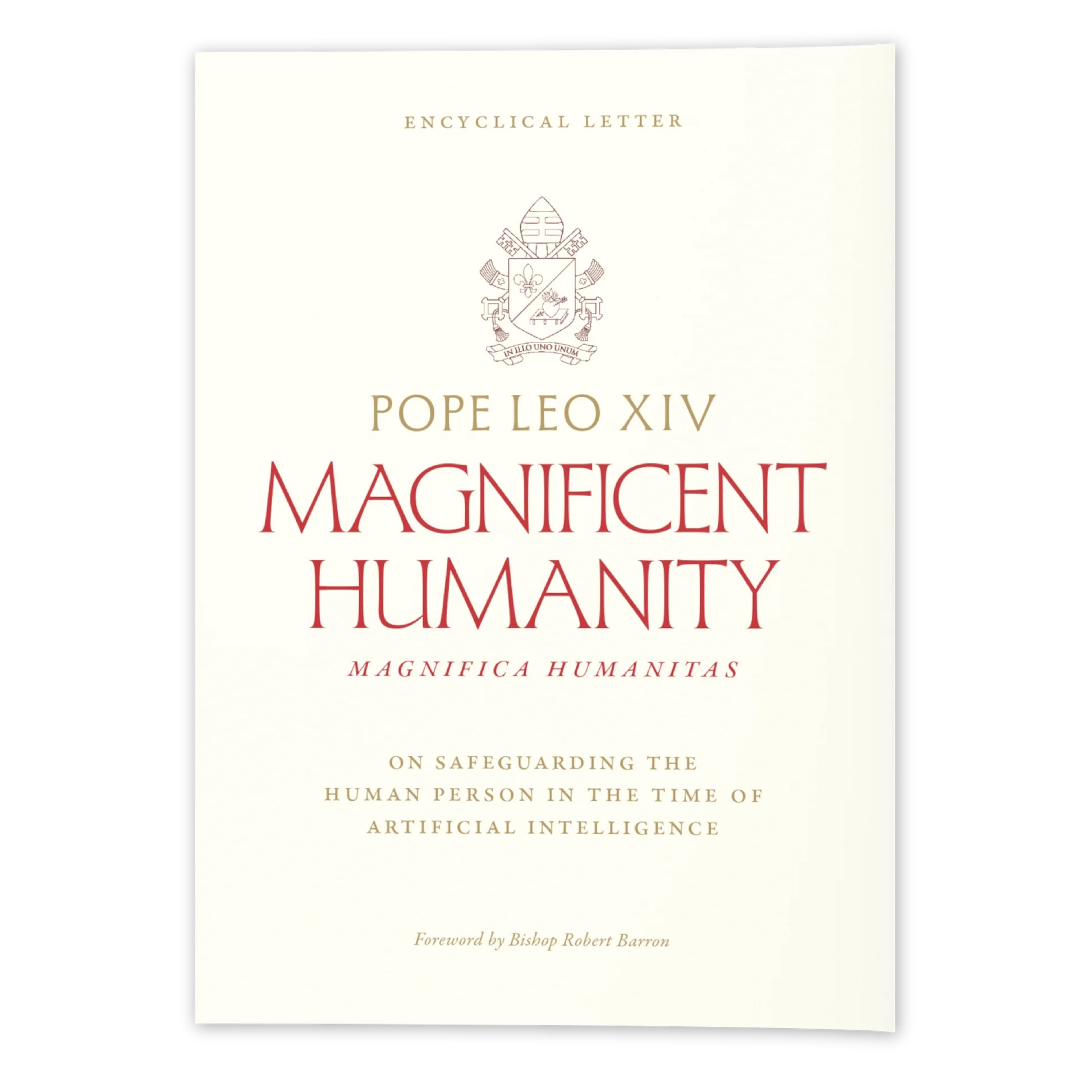
A companion essay to “The School of Wisdom in the Age of Artificial Intelligence.” This is a second reading of Pope Leo XIV’s first encyclical through the lens of how the Catholic and secular conversation has, in the first days following its release, begun to receive it.
The reception of papal teaching is itself a theological act. The Second Vatican Council recovered what an older, more juridical theology had obscured: that the ecclesia discens — the learning Church — is the indispensable partner of the ecclesia docens — the teaching Church — in the work of receiving, interiorizing, applying, developing, and sometimes contesting what has been taught. How the Church receives what the magisterium teaches reveals as much about the condition of the ecclesia discens at a given moment as the teaching itself reveals about the ecclesia docens.
This essay proposes a map of seven modes of reception in which the early Catholic and secular conversation about Magnifica Humanitas has unfolded. Theological reception, in which serious thinkers engage the encyclical’s content on its own terms. Pastoral reception, in which it is applied to specific communities and contexts. Critical reception, in which substantive theological pushback emerges from within the tradition. Journalistic-narrative reception, in which Vatican correspondents surface facts that theologians can think with. Institutional-curial reception, in which the document’s drafting process is read for what it reveals about the present condition of the Roman Curia. Strategic-political reception, in which institutional networks position themselves toward the pontificate through the act of public praise or qualified critique. And secular-elite reception, in which serious intellectuals engage the encyclical from outside the Church as an event of broader cultural significance.
The essay’s central argument is that the present moment in American Catholicism is institutionally polarized in ways that make faithful theological reception difficult, and that the ecclesia discens must recognize this in herself if she is to receive Magnifica Humanitas faithfully. The Holy Father has asked us to take up our section of the wall. He has not asked us to take up our section of a partisan trench.
I. Reception as a Theological Act
Magisterial teaching does not exist in an existential vacuum. It is given by the ecclesia docens — the teaching Church — but it lives only in the ecclesia discens — the learning Church that receives, interiorizes, applies, develops, and sometimes contests what has been taught. The Second Vatican Council recovered what an older, more juridical theology had obscured: that the sensus fidelium is a theological locus, that reception is a constitutive moment in the life of doctrine rather than a passive postscript to it, and that the Holy Spirit who guides the Pope’s teaching is the same Spirit who guides the Church’s reception of that teaching.
The ancient Church understood this. The Council of Nicaea in 325 did not become the Council of Nicaea simply because Constantine convened it or because the bishops signed the symbol. Nicaea became Nicaea because the Church, slowly and painfully over the course of decades, received the homoousion as the truth about the Son of God. Athanasius spent his life — five exiles, forty-six years of episcopal labor — defending a reception that for long stretches looked uncertain of completion. Newman, writing in 1859, recovered for the modern Church a fact the patristic age had taken for granted: that the consensus fidelium in the Arian controversy had, in places, preserved the faith more faithfully than significant portions of the episcopate did. Ecclesia discens is not subordinate to ecclesia docens in the order of intelligence; she is its complementary partner in the order of grace.
The Second Vatican Council made this explicit. Lumen Gentium 12 teaches that “the entire body of the faithful, anointed as they are by the Holy One, cannot err in matters of belief. They manifest this special property by means of the whole peoples’ supernatural discernment in matters of faith when from the Bishops down to the last of the lay faithful they show universal agreement in matters of faith and morals.” The Council does not collapse the distinction between teaching and learning; it shows that the distinction operates within a single ecclesial reality — the People of God — whose teaching and reception are jointly the work of the Holy Spirit.
Reception, then, is itself a theological act. How the Church receives what the magisterium teaches reveals as much about the condition of the ecclesia discens at a given moment as the teaching itself reveals about the ecclesia docens. And in the days following the release of Pope Leo XIV’s first encyclical, Magnifica Humanitas, we have begun to see what the present moment in the Catholic conversation looks like when it is asked to receive a major papal document on artificial intelligence.
What follows is one priest’s attempt to name what we are seeing. The essay does not aim to be exhaustive — the reception conversation continues, and significant voices have not yet spoken. But the first days have produced enough material to make some preliminary observations about how the encyclical is being received, and what those modes of reception reveal.
I propose a map of seven modes of reception, recognizing from the outset that the boundaries are illuminative rather than airtight, and that some voices straddle them. The categories are: theological reception, pastoral reception, critical reception, journalistic-narrative reception, institutional-curial reception, strategic-political reception, and secular-elite reception. Each category is a different kind of act that the receiving Church performs, and each tells us something different about the present condition of Catholic discourse.
II. Theological Reception
By theological reception I mean the act of engaging the encyclical’s content on its own terms, with an attempt to receive it whole and to think with it. The theological receiver does not ask first whether she agrees, or whether the document serves her institutional interests, or whether it can be wielded in some other argument. She asks: what is the Pope teaching, why is he teaching it, and how does it integrate with the Catholic tradition? She holds her own predispositions in abeyance long enough to let the document speak.
Several substantive theological receptions have appeared in the first days.
Larry Chapp, writing in Catholic World Report, has read the encyclical as “a pointed and prophetic gut punch” — beneath its deceptively gentle surface, a Christologically-grounded evangelical provocation. Chapp is a Balthasarian by training (his Fordham doctorate was on Hans Urs von Balthasar), runs a Dorothy Day Catholic Worker farm with his wife, and operates a blog literally named Gaudium et Spes 22. He reads the encyclical’s Babel/Nehemiah framing as authentically Augustinian — the libido dominandi (the lust for domination) of the City of Man versus the amor Dei (the love of God) of the City of God — and defends Leo’s “outdated” judgment on just war from within the just war tradition itself, on the grounds that AI-driven stateless warfare has dissolved the very presuppositions on which the classical theory rested.
Chapp matters because he breaks the pattern that some observers had expected of the theological right. He is unmistakably conservative in his theological formation. And yet he reads the encyclical whole, defending its social-doctrinal applications as integral to its Christological core. He demonstrates that the selective reception — to which we will turn shortly — is not the necessary response of conservative Catholicism. It is a particular choice that other conservatives are declining to make.
Matthew Shadle, writing at Window Light, has produced what is perhaps the most theologically focused engagement yet to appear: “More than a Ghost in a Shell”. Shadle frames his reading through Mamoru Oshii’s 1995 anime film as a cultural icon of the transhumanist longing for transcendence beyond the body. His central claim — that the encyclical’s key insight is the teaching at §118 that “humanity flourishes not despite limitations, but often through them” — converges with my own reading in the companion essay. But Shadle extends what I had not extended: the theological grounding of the school of wisdom in the kenosis of the Incarnation. “He takes upon himself our weakness and transforms it into a setting for salvation” (§232). The fulfillment of our longing for transcendence does not come, Shadle argues, through “the integration of humankind and technology” but through “the Infinite entering into our finitude and weakness.” This is theological reception in its full and proper form.
Steven Millies, writing for Religion News Service, has made what may be the single most consequential interpretive observation in the early commentary: that the encyclical’s diagnostic concept of “culture of power” functions as a successor to John Paul II’s culture of life. Millies, who directs the Bernardin Center at Catholic Theological Union and whose scholarly work centers on the consistent ethic of life tradition, sees in Leo’s “culture of power” a magisterial concept-name that holds together AI-driven domination, the militarization of the digital economy, autonomous weapons, populist polarization, and the new forms of slavery as expressions of a single underlying disorder. This is the Bernardin tradition recognizing its own development in the Leonine magisterium.
Michael Sean Winters, writing in National Catholic Reporter, has offered the most analytically substantive single commentary I have read: “The 3 most important themes in Magnifica Humanitas”. Winters identifies the encyclical’s deliberate use of “Catholic Social Doctrine” rather than the more common “Catholic Social Teaching” as a magisterial move of considerable importance. The choice of doctrine — with its dogmatic weight, its claim on the religious submission of intellect and will — signals that what is being articulated cannot be bracketed as a matter of prudential judgment about which serious Catholics may simply disagree. Winters is willing to push back substantively on §192’s “outdated” judgment of just war theory from his center-left position; we will return to him in the section on critical reception. But his identification of the doctrine / teaching terminological shift is theological reception of the first order.
Monsignor James Shea, writing in the National Catholic Register, has read the encyclical Christologically: as a document that “primarily addresses the rise of artificial intelligence... as arising not simply within an ‘era of change’ in which many developments occur within an otherwise steady framework, but within a true ‘change of era,’ in which the tectonic plates of the world’s social life are shifting beneath our feet.” Shea’s reading is anchored in the encyclical’s repeated affirmation of Gaudium et Spes 22 — that the mystery of humanity becomes clear only in the mystery of the Word made flesh. This is the Wojtyłan personalist key that operates throughout the document.
To the same category of theological reception I would add Meghan Clark in NCR on limitation as the pathway to spiritual growth and authentic humanity; Lavoisier Fernandes at Where Peter Is, whose “Ten Takeaways” brings a Goan-Indian Catholic perspective on the new colonialism of digital extraction; and Sister Sally Scholz’s reading of the slavery apology as “an enactment of concrete solidarity,” which I look forward to engaging when the NCR feature series develops it more fully.
The common feature of these theological receptions is that they engage the encyclical’s content with seriousness and a willingness to be taught by it. They are not uncritical — Shadle openly notes that the Nehemiah-wall image troubled him for reasons of his own, and Winters offers substantive pushback on §192. But they begin from the assumption that the document is theologically substantive and that the receiver’s task is to think with it.
III. Pastoral Reception
By pastoral reception I mean the act of applying the encyclical to a specific community, vocation, or pastoral context. Where theological reception thinks with the document, pastoral reception asks: what does this mean for the people in my care?
Cardinal Blase Cupich of Chicago, in his “Vatican News interview”, gives us the first full-length statement from a senior American cardinal. Cupich places the Babel/Nehemiah image at the structural center of his reception, and his choice is not accidental: the Nehemiah model is the synodal model. “This city comes to birth not through the initiative of one powerful individual, but through ‘the shared responsibility of all: men, women, priests, artisans, heads of households and young people all play a part.’” For the cardinal of Leo’s home archdiocese to elevate this passage is to signal to American Catholics that the encyclical is to be received as a summons to shared responsibility, not as a teaching to be debated from a position of detached judgment. His characterization of the encyclical as “a new lens for the Church’s Social Doctrine” gives episcopal authority to Winters’s observation about the doctrine / teaching terminology.
Father Brendan McGuire, the Irish-born former Silicon Valley technology executive who serves as pastor of St. Simon Parish in Los Altos — that is, in Silicon Valley itself — has offered in his Vatican News interview a pastoral reception of remarkable institutional depth. A parish priest immersed in the Silicon Valley conversation for years, he reveals that Chris Olah, who stood with the Holy Father at the encyclical’s presentation, is “a dear friend.” McGuire rejects the criticism that the Olah moment amounts to ecclesial cover for Anthropic by invoking Martin Luther King's 1967 anti-war address: "the fierce urgency of the present moment meant that silence would be betrayal." This is pastoral reception at its sharpest — a parish priest who has spent his ministry among the people the encyclical addresses, speaking with the authority of one who has heard the actual confessions of the tech industry.
Father James Martin, S.J., writing in America, has performed a pastoral reception calibrated to a particular American audience: educated Catholics formed in business schools and professional graduate programs. His “The most cogent Catholic critique of capitalism that I have ever read” opens with his own Wharton credential and proceeds to walk readers through the encyclical’s economic teaching with the patience and accessibility of a director of the Spiritual Exercises. This is pastoral reception in the Ignatian manner — meeting the reader where the reader is, in language the reader can hear, and gradually leading her into the depth of what the encyclical actually teaches.
Father Thomas Reese, S.J., the dean of senior American Jesuit Vatican commentary, has given the broadest pastoral reception of all in his “With his first encyclical, Pope Leo hits it out of the ballpark”. The colloquial tone is calibrated to a non-specialist American Catholic readership; the Chicago/White Sox baseball idiom is calibrated to Leo's own Chicago roots. Reese is not doing theological analysis. He is giving a senior Jesuit’s pastoral verdict in language that will travel. That verdict — that this is “a great introduction” for the new reader and “an excellent review” for the familiar one — does the institutional work of authorizing American Catholic warmth toward the encyclical.
What these pastoral receptions share is that they ask the encyclical to do work in a specific community. The reception is calibrated to its hearers. The teaching becomes living in the people of God only when it is received pastorally — when bishops, priests, and lay leaders ask it to address actual lives.
IV. Critical Reception
By critical reception I mean substantive theological pushback on specific elements of the encyclical from within the tradition. Critical reception is not rejection. It is the act of receiving the document seriously enough to engage it critically — to test particular formulations, to ask whether they cohere with the broader tradition, to propose corrections or developments. The patristic Church developed her doctrine in part through this kind of engagement, and the post-Vatican II Church has continued to recognize the legitimate place of theological pushback as a moment in the potential development of doctrine.
Michael Sean Winters, having identified the encyclical’s deliberate terminological move to “Social Doctrine,” nevertheless offers what is to date the most substantial criticism of §192: that the just war framework “remains a necessary tool of analysis as the pope’s conditional phrase ‘without prejudice to the right to self-defense’ implies. Just war theory has been abused and the abuses should be addressed. Just as a prescription drug can be abused, but is nonetheless capable of helping someone in pain, just war theory remains essential to the church’s moral compass.” Winters has identified the precise interpretive ground on which much of the American Catholic conversation about §192 will play out. His pushback comes from the center-left, not the right, which makes it the more challenging to dismiss. I read the magisterial development differently than Winters does, but his critique deserves engagement, not dismissal.
Sister Ilia Delio, OSF, the Franciscan theologian at Villanova and the leading American Catholic voice for an evolutionary cosmology in conversation with Teilhard de Chardin, has offered in her “Remaining Human or Becoming Human” the most substantive theological critique of the encyclical from the Catholic left. Delio’s three critiques are these: that the encyclical’s anthropology is misordered (”to begin an anthropology with the grandeur of the human rather than the grandeur of the cosmos that produced it is already to begin in the wrong place”); that posthumanism, properly understood, is not the encyclical’s antagonist but a Christian openness to being transformed by relationship with technology; and that the Nehemiah-wall image is defensively backward-looking — “safeguarding, of guarding a grandeur already given... of what must not be lost“ — rather than open to the new emergence the Spirit may be producing.
I do not agree with Delio’s critique, and I think the Catholic tradition’s hesitation about posthumanism is well-founded for the reasons I have articulated in the companion essay. But Delio’s voice belongs in the reception spectrum because she represents a genuine theological position held by serious Catholic thinkers, particularly in the Franciscan and Teilhardian traditions, and her critique forces the rest of us to articulate more carefully what we mean by “remaining human” and why we believe the rebuilding of the wall is precisely not a defensive posture.
Ross Douthat, writing in the New York Times, has offered in “Pope Leo Isn’t Standing Athwart the Singularity” what is in many respects the most theologically serious secular-press reception, precisely because he writes from inside the Catholic tradition. Douthat’s critique is the opposite of Delio’s: not that the encyclical is too anthropocentric but that it treats AI as “ultimately a normal technology” and “doesn’t really give the time of day” to the genuine strangeness of the moment. Douthat surfaces, for the first time in print, Olah’s actual remarks at the Vatican presentation — Olah’s claim that Anthropic researchers find in their models “internal states that functionally mirror joy, satisfaction, fear, grief and unease.” Douthat reads this as gently contradicting the Pope’s categorical distinction at §99. His central worry: that the encyclical’s brusque dismissal of AI personhood is “a starting point for some future intervention, not an argument ender that anyone in Silicon Valley is likely to accept.”
Douthat is right that §99 will not by itself persuade Silicon Valley, and his critique is one I take seriously. But I would respond, as I have in the companion essay, that what §99 names — the categorical distinction between simulation and lived experience — is precisely what §119–122 develops into the theological substance that makes the distinction persuasive. The encyclical’s argument is not exhausted by §99; it is articulated across the whole anthropological chapter, and Douthat’s wish for “more on the weirdness” of the moment is in significant part met by the school-of-wisdom material he does not engage. But the critique is fair, and it points to the work that Catholic theology will need to do in the coming years to make the encyclical’s anthropology persuasive in a Silicon Valley idiom.
Matthew Walther, writing in the New York Times in his “The Pope Should Be Going to War Against A.I. Why Isn’t He?”, offers the critique from the integralist right: that Leo has been insufficiently radical, that he should have summarily condemned AI rather than calling for dialogue with the industry that produces it. The encyclical has thus elicited substantive criticism from both directions — Delio thinks Leo too defensive of an already-given humanity, Walther thinks him too accommodating with a technology that should be refused outright. That the document draws fire from both ends is itself a kind of testimony to its placement. Critical reception, in all of these instances, takes the document seriously. The critic does not bracket the encyclical as a “policy matter” to be sidestepped. She engages it as a theological intervention requiring theological response. This is precisely what the ecclesia discens is called to do.
V. Journalistic-Narrative Reception
By journalistic-narrative reception I mean the work of professional journalists describing the encyclical’s release, presentation, and significance as a public event — without primarily engaging its theological content. This is the work of the Vatican correspondents, the religion-news reporters, the wire services. It is essential work, and the better practitioners of it offer real value to the reception conversation by surfacing details that the theologians have not yet attended to.
Gerard O’Connell, writing in America, has given us the most authoritative single account of the presentation event. Elizabeth Dias, writing in the New York Times, has given us the most politically alert account, framing the encyclical as continuous with Leo’s broader challenges to American institutional power on immigration and war. Christopher White and his colleagues at the National Catholic Reporter have given us the most extensive coverage of the Anthropic-Pentagon backstory and the institutional logic of the Olah moment. Luke Coppen has given The Pillar readers a careful “Reader’s Guide” with the citation analysis we needed: Pope Francis is the most-cited figure in the encyclical, followed by Saint John Paul II. The figure of continuity is empirical, not interpretive.
Journalistic-narrative reception is essential because it surfaces facts that change the analytical conversation. We did not know, before Dias, that Leo had explicitly said “in the name of the church I accept your invitation to walk together” to Olah. We did not know, before Douthat, the full content of Olah’s own remarks. Many did not know, before NCR, that Anthropic had lost a Pentagon contract for refusing to militarize its technology. The journalists made these facts available; the theologians can now think with them.
I would also gently note the work of Father Bill Grimm, M.M., writing for Global Catholic and UCA News — “Anthropic Before the Pope: Seeking Church’s Help” — which serves both journalistic and pastoral functions. Grimm is the first commentator to take seriously the concern that the Olah moment may serve as ecclesial cover for a company under regulatory and political pressure, rather than simply batting it away. He writes from Asia, with the perspective of a Maryknoll missionary, and his sober acknowledgment that “the concerns are plausible” is the kind of honest critical realism the conversation needs.
VI. Institutional-Curial Reception
There is a further mode of reception that deserves brief acknowledgment, distinct from journalistic narrative because it engages not the encyclical itself but the institutional life of the Holy See that produced it. Andrea Gagliarducci, the vaticanista of ACI Stampa and Monday Vatican who is among the most institutionally informed Vatican journalists writing today, has offered in his “Leo XIV: What does his first encyclical tell us?” an institutional reading of the encyclical’s drafting process. His observations are sobering.
The encyclical, Gagliarducci reports, was prepared by the Dicastery for the Promotion of Integral Human Development under Cardinal Czerny, with experts gathered piecemeal and the document held in strict confidentiality. The Office of Latin Letters received the complete text last, which is why no Latin editio typica yet exists. More consequentially, the document appears to have been drafted in significant isolation from other Vatican initiatives on artificial intelligence: there is no reference to the Rome Call for AI Ethics of the Pontifical Academy for Life, no engagement with Archbishop Gallagher’s 2023 United Nations proposal on global AI governance, and only a single citation of the recent Antiqua et Nova of the Dicasteries for the Doctrine of the Faith and for Culture and Education — and that citation appears in footnote 123. The result, in Gagliarducci’s reading, is “a document by experts, but not a collegial document of the Roman Curia.”
I do not have the institutional knowledge to assess the accuracy of Gagliarducci’s reporting, and I would observe that his framing has its own polemical edge — Monday Vatican operates within a particular set of curial sympathies that the careful reader will want to weigh. But the institutional observation itself is serious and deserves engagement: that the curia Leo XIV has inherited is still divided, that interdicasterial coordination on a question as consequential as artificial intelligence is more fragmented than it ought to be, and that the Leonine reform of the curia is still a work in progress. None of this diminishes the substantive theological achievement of Magnifica Humanitas. But it reminds the ecclesia discens that the magisterial documents we receive are produced within institutional structures that themselves require continued reform, and that the Holy Father’s call to “rebuild relationships before rebuilding with stones” is a call addressed first, perhaps, to the Roman Curia itself.
VII. Strategic-Political Reception
This is the most delicate category to name, and it is the one I want to dwell on most carefully — because it is happening in plain sight, and because the Church needs to be able to see it clearly without descending into uncharitable accusations against individuals.
By strategic-political reception I mean the act of public praise (or qualified critique) that performs a positioning function for institutional networks relative to Rome. The receiver may well sincerely believe everything she or he writes. The strategic dimension is not located in the content of the praise but in the act of giving it — and particularly in the contrast between the act and the previous posture of the network the receiver represents.
The cleanest single example of strategic-political reception in the first days has come from Mr. Tim Busch, writing in the National Catholic Register in “Pope Leo XIV Gives AI Historical — and Theological — Perspective”. Mr. Busch is the founder of the Busch Firm in Irvine, California, and the founder of the Napa Institute, one of the most institutionally consequential American Catholic lay organizations of the post-2010 conservative ascendancy. Through his Napa Institute conferences at the Meritage Resort, his foundation’s substantial philanthropy to Catholic education (including JSerra Catholic High School in San Juan Capistrano, of which I have some local knowledge, and the Busch School of Business at Catholic University of America), and his philanthropic and editorial networks, Mr. Busch has been one of the principal organizers of American Catholic conservatism during the pontificate of Pope Francis.
That pontificate, it is fair to say, did not always receive a warm reception from the Napa Institute orbit. The institution’s conferences regularly featured speakers and panels that were openly critical of Amoris Laetitia, of Laudato Si’, of Fratelli Tutti, and of the broader Bergoglian magisterium on questions ranging from the death penalty to the universal destination of goods. This is not a polemical characterization; it is a matter of public record, and Mr. Busch has himself responded to characterizations of his network as anti-Francis with appropriate nuance and care.
What is striking about Mr. Busch’s Register commentary on Magnifica Humanitas is its tone: “Through Magnifica Humanitas, Pope Leo XIV has struck the chord that modern society most needs to hear.” This is, on its face, a wholehearted reception. And one notes that an encyclical called by this commentary “the exact right message for the moment” contains §192 declaring the just war theory “outdated”; contains §173–177 apologizing for the Church’s complicity in slavery and naming specific papal bulls of Eugenius IV and Nicholas V; contains §67 extending the universal destination of goods to patents, algorithms, digital platforms, and data; contains §34 reaffirming Dignitatis Humanae against precisely the position the Society of Saint Pius X had declared one day earlier; and contains §66’s teaching that the Christian tradition “has never recognized the right to private property as absolute or inviolable.” These are not the positions for which Napa Institute conferences were known under Francis.
I do not impugn Mr. Busch’s sincerity. The act of public reception, however, performs a function beyond its theological content. The Napa Institute’s institutional embrace of Magnifica Humanitas — and the broader pattern of warm reception in the National Catholic Register, the EWTN-affiliated outlet — signals something about how the American Catholic right has read the new pontificate. They have read Leo’s American identity, his Augustinian formation, his careful magisterial method, and his theological caution — and concluded that this is a pontificate they can publicly embrace. The political-theological calculation is unmistakable: build relational capital with the pontificate now, on the social-doctrinal core, and reserve criticism for specific prudential applications they cannot accept (which will be framed, as Phillips and Weigel have already framed it, as “policy debate”).
This is the category in which I would also place Jacob Phillips’s First Things reception of the encyclical as “A Boomer, But an Augustinian” and George Weigel’s Washington Post reception “Babel or Jerusalem? Pope Leo weighs AI and the human condition”. Both perform the same structural move: praise the encyclical’s anthropological-Christological core while bracketing its social-political-economic applications as matters of “policy debate” about which serious Catholics may disagree.
The move is graceful in both cases. Phillips frames it as a question of generational interpretation: Leo is “Boomer” in his commitments to international institutions and the multilateral order, but “Augustinian” in his deeper anthropology, and what is enduring in the encyclical is the latter. Weigel frames it as a question of “intellectual and spiritual scaffolding” that “shouldn’t get lost in the policy debate.” Both writers praise the encyclical generously. Both writers, having praised it, leave its most consequential developments — Leo’s “outdated” judgment on just war in §192, the slavery apology in §173–177, the autonomous weapons teaching in §197–200, the reaffirmation of Dignitatis Humanae in §34 — almost entirely unaddressed.
I have spent some time, in my engagement with these pieces, pointing out what their separation of “anthropology” from “applications” overlooks: that Magnifica Humanitas consistently uses “Catholic Social Doctrine” rather than “Catholic Social Teaching,” and that the choice carries doctrinal weight that cannot be bracketed by appeal to prudential judgment. Honest theological reception of the encyclical requires engaging what it says, including the developments that one finds difficult. The Phillips-Weigel-Busch pattern, however graceful, is an incomplete reception of what the Holy Father has actually given the Church.
But the deeper observation is this: strategic-political reception is not unique to the Catholic right. The Catholic progressive press has also performed strategic receptions in the post-2013 era, sometimes by reading Francis’s documents through frames Francis himself would not have endorsed. The phenomenon is not new and not partisan. What is visible about the present moment is that the American Catholic right, having spent over a decade in a posture of public criticism of the Holy See, has rapidly pivoted to a posture of public embrace. The pivot has happened so quickly that it would be theologically irresponsible not to name it.
What does the strategic-political reception tell us about the ecclesia discens at this moment? I would suggest that it tells us something important about the depth of the institutional polarization of the American Church — that significant networks within American Catholicism now relate to the pontificate primarily in terms of political alignment rather than in terms of theological listening. When such networks find a pontificate they can align with, the embrace is rapid and total. When they find a pontificate they cannot align with, the criticism is rapid and total. In neither case is the deeper work of theological reception — the work of patient, sustained, sometimes uncomfortable listening — fully visible.
This is, I think, the diagnosis the ecclesia discens must make of herself in receiving Magnifica Humanitas. Not that any individual receiver is acting in bad faith, but that the institutional climate has habituated us to receive papal teaching first politically and only second theologically. The Holy Father’s first encyclical asks us to do better than that. Whether we can is itself a question the reception will answer over the coming months.
VIII. Secular-Elite Reception
By secular-elite reception I mean engagement with the encyclical from outside the Church, by serious secular intellectuals who treat the document as a cultural and political event of broader significance than its immediate ecclesial audience.
The most substantial secular-elite reception to date has come from Jill Lepore in the New Yorker: “Pope Leo’s Encyclical on AI”. Lepore is the David Woods Kemper Professor of American History at Harvard and one of the most consequential American public intellectuals of her generation. She is also, as her piece declares at its close, herself a Catholic. Her reading is the most rhetorically devastating thing yet written about the AI industry by anyone outside the encyclical itself: that “for years — for decades — tech leaders have described their investments and inventions, their corporations, and even themselves in religious terms, and specifically in messianic terms.” Silicon Valley has been operating as a rival religious tradition, with its own gospel, missionaries, vestments, homilies, sacraments, and eschatology. Magnifica Humanitas is, in this reading, the moment at which the actual Catholic Church names the false religion that has been quietly displacing her in Silicon Valley and reasserts the prerogative of her own teaching authority.
Lepore’s reading is the kind of analytical observation only a serious historian could make, and it gives the encyclical an interpretive frame — the contest of two churches with two gospels — that no Catholic commentator has matched. Her closing line, after the predictable Silicon Valley response on social media (”’Bad take from the Pope,’ one tech bro tweeted”), is one of the cleanest things written in the early reception: “Nice. I’ll pray for you guys.”
Ross Douthat, also in the New York Times, straddles the boundary between secular-elite reception and theological critical reception. We have engaged him above.
What is striking about the secular-elite reception is its seriousness. The major secular publications of the American educated class — the New Yorker, the New York Times, the Washington Post, CNN, Time — have treated Magnifica Humanitas as a document of significance, given it substantial space, and engaged it with theological literacy. This is not the reception of an encyclical from a Pope dismissed as irrelevant by the broader culture. This is the reception of a magisterial document that the secular world recognizes as having genuine bearing on its most consequential present debate.
For the Holy Father’s first encyclical to occasion this kind of secular-elite engagement is itself a magisterial achievement of the first order. Laudato Si’ did this with climate. Magnifica Humanitas is doing it with artificial intelligence. That alone is news.
IX. What the Reception Reveals
The categories above are not airtight, and some voices straddle them. Douthat is both theologically engaged and secular-elite. Cupich’s interview is both pastoral and journalistic-narrative. Chapp’s piece is theological reception but contains elements of pastoral and critical engagement. The framework is illuminative, not exhaustive.
What does the spectrum of reception tell us about the ecclesia discens at this moment?
First: that the Catholic theological conversation is alive. We have substantive theological reception from across the spectrum — Balthasarian (Chapp), kenotic (Shadle), Bernardin (Millies), Wojtyłan personalist (Shea), center-left analytical (Winters), Franciscan-Teilhardian (Delio), Global South diaspora (Fernandes). The Church has not lost the capacity for serious theological engagement with magisterial teaching, even in a moment characterized by polarization.
Second: that the separation of the encyclical’s “anthropological core” from its social applications, characteristic of certain Catholic neoconservative reception, is not the necessary response of the theological right. Chapp, Shea, Towell, and the broader Register multi-author reception demonstrate that a Catholic conservative formation can produce theological engagement with the whole document. The bracketing is a particular choice that not all conservatives are making.
Third: that the secular elite is receiving Magnifica Humanitas with unusual theological seriousness, in part because the Anthropic-Vatican relationship has given the encyclical a level of public-political profile that few magisterial documents achieve.
Fourth — and this is the observation I want to leave with the reader — that the ecclesia discens at this moment is partially constituted by institutional networks (think tanks, foundations, media outlets, philanthropic structures) whose relationship to the pontificate is more political than theological. When such networks find a pontificate they can align with, the embrace is rapid and total. The strategic-political reception of Magnifica Humanitas by figures and networks that were previously sharply critical of the magisterium is not, in itself, a sinful act. But it is an act that the rest of the ecclesia discens should be able to see for what it is. The Church receives papal teaching most faithfully not when she aligns it with her prior commitments but when she allows it to challenge those commitments, develop them, and sometimes overturn them.
A partial qualification is in order before I close. James F. Keating of Providence College, in his First Things-affiliated newsletter The Fourth Watch, has read the same reception conversation I have just described and drawn a different conclusion. The polarized Catholic in-fighting over Magnifica Humanitas, Keating suggests, is itself a sign of the Church’s continuing cultural relevance — evidence that what the Pope says still has weight, that the magisterium is still treated as consequential by both its defenders and its critics. Love it or hate it, Catholics still fight about it. This is, Keating argues, a hopeful sign rather than a discouraging one.
Keating is not wrong. A Church whose teaching no one engaged would be a Church no one took seriously, and the reaction to Magnifica Humanitas is indeed evidence that the magisterium remains a force the surrounding culture cannot ignore. To this extent the polarization is itself testimony. But the deeper question is which observation we make central. Keating's reading and my own can both be true: the storm is evidence of relevance, and the storm is evidence of polarization. The work of the ecclesia discens is not exhausted by either. It is the slower work that comes after — the patient theological listening that allows the magisterium to teach rather than merely to occasion fighting.
That is the work of reception. It is the work of ecclesia discens. And in the months and years ahead, Magnifica Humanitas will be more or less faithfully received, depending on whether the receiving Church can recognize her own polarization and resist the easy categorical placements of an encyclical that is, in fact, doctrine.
The Holy Father has asked us to take up our section of the wall. He has not asked us to take up our section of a partisan trench. The first will require of us the slow work of theological listening. The second is easier, more familiar, and more comfortable — and it is precisely what the encyclical, in its quiet way, refuses to permit.
Comments, reactions, and additional voices for inclusion in subsequent updates are warmly invited.
Monsignor Arthur Holquin, S.T.L., is a retired priest of the Diocese of Orange and retired rector of Mission Basilica San Juan Capistrano. He publishes Liturgy and Truth on Substack.
A superb and comprehensive report on the reception of Pope Leo's first encyclical. Very illuminating from the incredibly well read Californian Monsignor and brilliantly communicated in understandable and eloquent prose.
Oh my goodness! Thankyou for this capacious context for Reception of MH. Exhaustingly thorough. How do you do it?
Here is my ongoing question: We are, all of us, being changed minute by minute, consciously or unconsciously, by this radical change. It is not static but alarmingly and amazingly dynamic. As Walter Ong, SJ, said years ago... we construct it and it constructs us, changing our consciousness faster than we can get hold of it.
This encyclical is powerful and necessary but it is a product of " print-age brain" in a world gone digital.
It is important to mine its doctrinal, pastoral and social sign-posts but the real work will be to take its thousands of words into other ways of communicating. All of this within an ongoing, human relationship which is dynamically changing at a pace the institutional church ( Curia and Bishops Conferences) is not accustomed to but which, in the urgency of this moment, must somehow adopt
to even remain in the conversation. Is this even possible? Agonizingly slow" study" and deliberation has been touted, for centuries, as a church virtue; will it be its downfall in the face of this challenge? I hope not.
Thank you, Monsignor, for your great mind and diligent work. I look forward to your posts.