Easter Wednesday

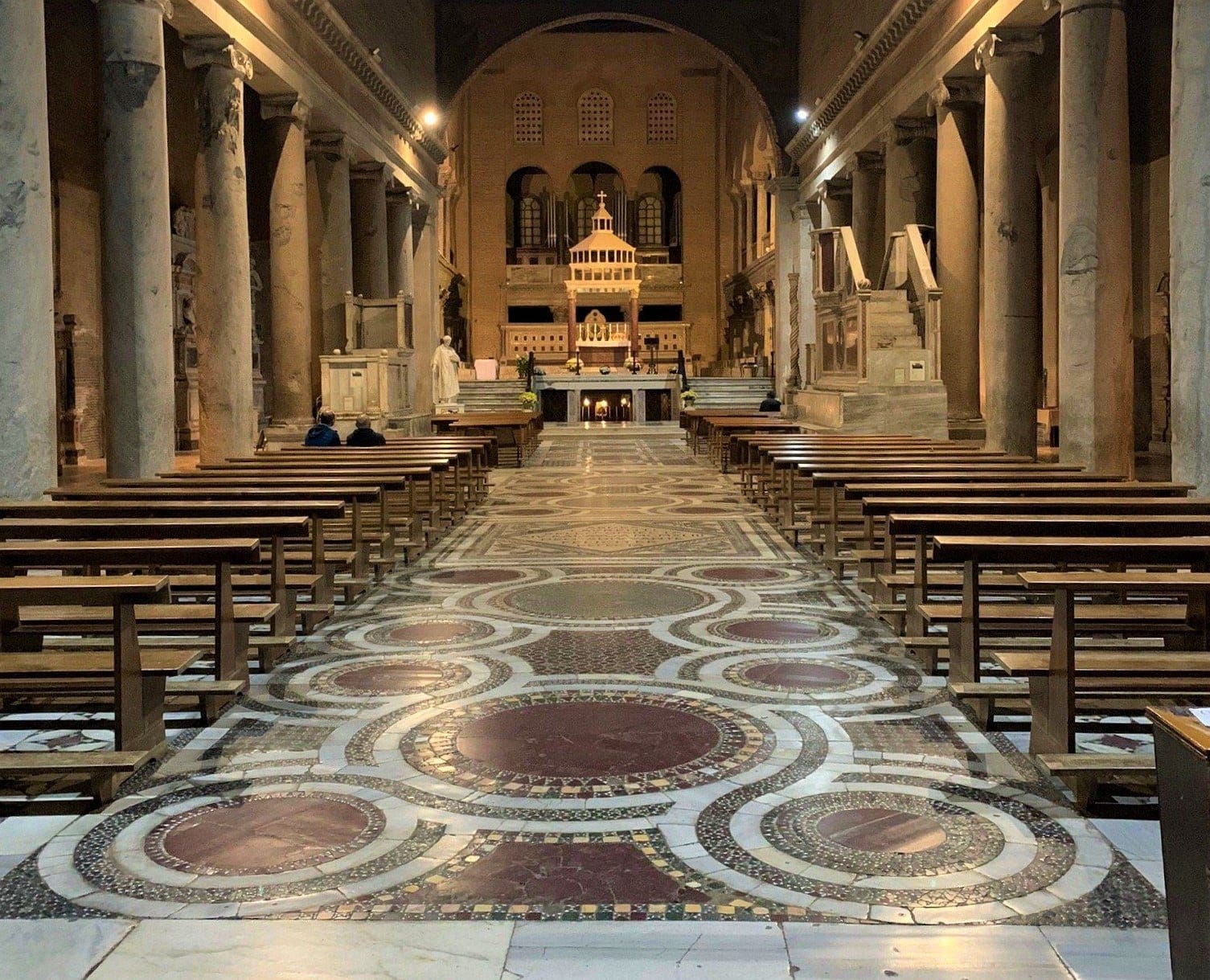
Stational Basilica of San Lorenzo fuori le Mura
Outside the walls — fuori le Mura — because Lawrence was buried where he died, beyond the Aurelian wall, on the Via Tiburtina. The deacon Lawrence was martyred in 258 under the Emperor Valerian, and the story of his death — roasted on a gridiron, reportedly saying to his executioners, “Turn me over; I am done on this side” — became one of the most celebrated martyrdom narratives in the early Church. Constantine built a modest oratory over his grave; successive popes enlarged and embellished it until Pelagius II, in the sixth century, created the magnificent basilica that still stands. Adjacent to the basilica is the Campo Verano, Rome’s great civic cemetery, so that San Lorenzo fuori le Mura has always stood at the threshold of death — and defied it. On Easter Wednesday, the Church assigns this basilica the station, and assigns the road to Emmaus as the Gospel. Both the place and the text speak of the same thing: the Risen Lord encountered on the way, transforming a journey of despair into a return of joy.
First Reading: Acts 3:1-10 Peter heals the man lame from birth at the Beautiful Gate of the Temple
Responsorial Psalm: Psalm 105:1-4, 6-9 “Rejoice, O hearts that seek the Lord”
Gospel: Luke 24:13-35 The road to Emmaus — made known in the breaking of the bread
Seven miles. The road from Jerusalem to Emmaus is seven miles, and two of the disciples are walking it in the wrong direction — away from the upper room, away from the community, away from the confusion and grief that has no resolution. They are walking, as grief always walks, toward the familiar: home, distance, the relief of putting it all behind them.
A stranger falls into step beside them.
Luke gives us one of the most humanly observed details in all of Scripture: “their eyes were prevented from recognizing him.” Not that he was disguised. Not that he looked different. Their eyes were prevented. Grief does that. It films over the lens of perception. The Risen Lord is walking beside us and we are explaining to him, with great thoroughness, why hope is no longer reasonable.
“We were hoping that he would be the one to redeem Israel.” The past tense is the sound of a faith that has given up. We were hoping. Something in us recognizes how often we speak of God’s promises in that register — as things we once believed, before the tomb sealed them away.
But notice what the stranger does. He does not argue. He does not produce evidence. He opens the Scriptures, and beginning with Moses and the prophets, he interprets to them what pertains to him in every passage. He walks them through the whole story — the long, patient, often painful story — and shows them that what felt like catastrophe was in fact the shape that salvation was always going to take. Was it not necessary that the Christ should suffer?
Their hearts burn within them. They do not know yet why. But something is being relit.
And then, at table, in the breaking of the bread — the eyes open. Recognition comes not in argument but in liturgy. He is made known to them in the breaking of the bread, and in that same moment he vanishes. He does not need to stay. They have what they came for. They turn around — all seven miles, at night — and run back to the community they had abandoned.
The Risen Lord meets us on the roads we take in the wrong direction. He walks with us patiently through the Scriptures we have read but not yet understood. He waits for the moment of the breaking of the bread.
Then he sends us back.
Thank you, Monsignor. I never really paid attention to the going back part... Because for years I've read the passage in an apologetic way, focusing mostly on the real presence in the Eucharist. There is so much in this gospel passage to meditate on!
Blessings on you, MSGE Holquin.
I respond to your writings on multiple levels. I will start with the first, which is that of an experienced physician who knows that each human baby is born with a unique tiny body, mind, and soul, and each has a different capacity to withstand different types of pain, whether emotional, financial, physical, psychological, social, or spiritual. The pain centres in the human brain are unable to differentiate between these types of pain, and we also have different pain receptors.
Today, many young people self-harm because of severe emotional, psychological, social and spiritual pain, and so I become intensely concerned when any infliction of pain is glorified. I have never found that when I am experiencing agony or with other people experiencing agony, my capacity to love and, more importantly, to radiate the love and peace and goodwill that are essential for healing and restoration improves.
Recently, I read the testimony of a Ukrainian priest tortured by Russian soldiers who endured much agony and then came to a place of Peace with the Lord. My Vietnamese brother-in-law has a mystical experience whilst enduring the deprivations of a Viet Cong concentration camp after the war, and he too shared that he felt surrounded by Love and Peace. Two other men shared similar experiences with me that occured spontaneously when they were young, and that converted one into becoming an evangelical Christian, and the other, who is also an Irish Roman Catholic, prays the prayers of MeisterEckhart every morning from 05.00 - 06.00 AM ever since.
My fear is that Teachings about Pain and Suffering likely need to be received in a supportive community with an experienced Guide like yourself, and perhaps others who comment and not everyone has access to such a community.
Bennachtaí na Cásca, Blessings of Easter to you and all in this community.