Easter Tuesday

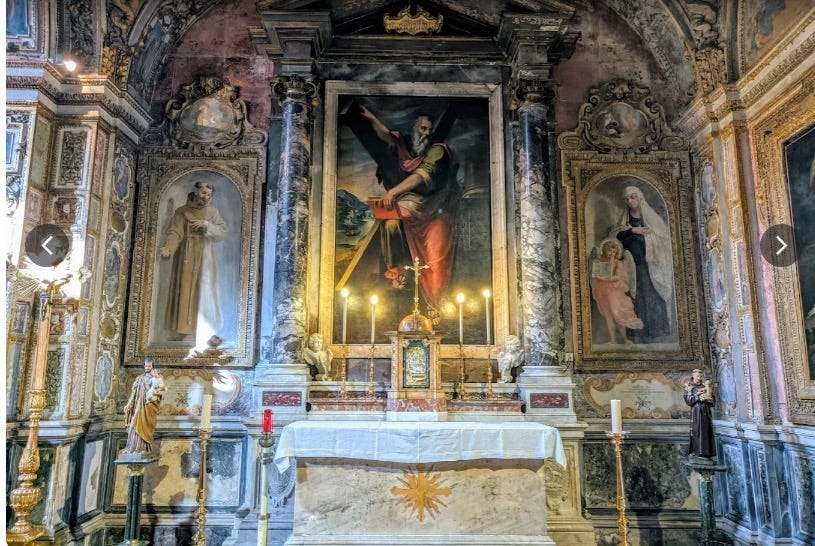
Stational Basilica of Sant’Angelo in Pescheria
The name is evocative and strange: Saint Angelo in the Fish Market. The basilica stands at the edge of what was ancient Rome’s great fish market, the Pescheria, set against the massive ruins of the Portico of Octavia — built by Augustus in honor of his sister — whose marble columns still frame the church’s entrance, antiquity and Christianity inhabiting the same stone. The church itself was consecrated in 770 by Pope Stephen III and takes its name from a vision of the Archangel Michael said to have appeared above the nearby Theatre of Marcellus. To reach this church is to walk through layers of time: republican Rome, imperial Rome, medieval Rome, and the living Church all pressing against one another in a single city block. It is, perhaps, the ideal station for Easter Tuesday, when the Gospel gives us the scene of Mary Magdalene weeping in the garden — a woman standing at the intersection of grief and glory, the old world and the new, unable yet to recognize that the one she is seeking is already present.
First Reading: Acts 2:36-41 “God has made him both Lord and Christ — this Jesus whom you crucified”
Responsorial Psalm: Psalm 33:4-5, 18-20, 22 “The earth is full of the goodness of the Lord”
Gospel: John 20:11-18 Mary Magdalene at the tomb — “Mary!” — “Rabboni!” — the apostle to the apostles
She supposed him to be the gardener.
Of all the details in John’s resurrection narrative, this one stops me every time. Mary Magdalene — who had followed Jesus from Galilee, who had stood at the foot of the cross when the disciples fled, who had come to the tomb in the earliest darkness — does not recognize him. She is looking directly at the Risen Christ and sees only a gardener.
We should not be too quick to judge her. We do the same thing every day.
The Risen Lord is present. He is not absent from our world, our suffering, our ordinary hours. But we are weeping — and grief narrows the vision to the size of the loss. The tomb is empty and we are still looking into it, still cataloguing what is missing, still asking the gardener if he has moved the body somewhere we can find it and at least perform the dignified rituals of finality.
Then he speaks her name.
Mary.
One word. Her name, in his voice, and the whole world reorganizes itself. Rabboni. Teacher. Everything that had shattered on Friday reintegrates in a single syllable. She is known. She is called. She is sent.
Go to my brothers and tell them.
The Church’s tradition has given Mary Magdalene a title she richly deserves: apostola apostolorum — the apostle to the apostles. Before Peter received his commission, before the eleven were gathered in the upper room, before Pentecost reorganized the world — Mary was sent. She carried the first Easter proclamation to those who would carry it to the ends of the earth.
Today, the Risen Lord knows your name. He is speaking it into whatever grief has narrowed your vision. The gardener is not a gardener. Turn around. Listen. Go and tell.
Thank you so much, Msgr Arthur Holquin, for this beautiful meditation on that intimate and personal encounter between the ressurected Jesus and Mary Magdalene. I deeply love that moment, when Jesus' voice inundated Mary's heart with comfort, hope and reassurance of His presence in her life! Thank you! 💗🙏🏻