Easter Thursday

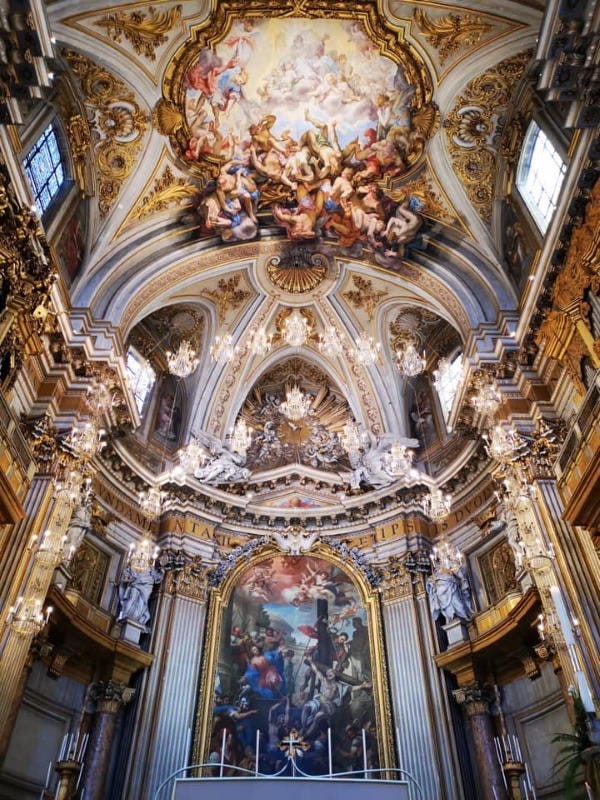
Stational Basilica of Santi Apostoli
The Basilica of the Holy Apostles stands in the heart of Rome, a short walk from the Quirinal and the Trevi Fountain, its unassuming façade concealing one of the oldest and most storied churches in the city. Founded in the sixth century by Pope Pelagius I and completed by John III to commemorate a victory over the Goths, it was dedicated to the apostles Philip and James, whose relics rest beneath the high altar. For centuries the basilica served as the titular church of powerful families — the Colonna, the della Rovere — and its walls contain the tomb of Clement XIV and a monument to the last of the Stuart pretenders. But its significance on Easter Thursday runs deeper than any dynastic history. On this day, the Gospel places the Risen Christ in the midst of his apostles — breathing peace upon them, opening their minds to the Scriptures, commissioning them as witnesses. The Basilica of the Apostles is precisely the right place to hear that the Church’s mission was not conceived in a boardroom or a synod hall, but in a locked room, by a Risen Lord who walked through walls to find his frightened friends.
First Reading: Acts 3:11-26 Peter’s address in the portico of Solomon — “You denied the Holy and Righteous One”
Responsorial Psalm: Psalm 8:2, 5-9 “O Lord, our God, how wonderful your name in all the earth”
Gospel: Luke 24:35-48 The appearance to the eleven — “Peace be with you” — he opens their minds to the Scriptures
“Peace be with you.”
He says it twice. Luke notes it with a quiet insistence that rewards attention. He appears among them — suddenly, inexplicably, the doors still locked — and the first word is not reproach, not explanation, not the settling of accounts. It is peace. He says it again: Peace be with you. And then, to dispel the ghost-terror that has seized them, he shows them his hands and his feet.
The wounds are still there. This is important. The Resurrection did not erase the crucifixion. The glorified body of the Risen Lord still bears the marks of what was done to it. Christianity does not resolve suffering by pretending it did not happen. It transforms suffering by passing through it — and the transformation retains the memory of the passage.
Thomas will not be in the room until Sunday. But the other disciples are here, and Jesus does with them what he did on the road to Emmaus: he opens their minds to understand the Scriptures. The story they thought they knew — the Torah, the prophets, the psalms — turns out to have been about him all along. The stone the builders rejected. The suffering servant. The one whose bones would not be broken. They had read these texts for years without understanding them as a single trajectory pointing here, to this room, to this moment.
Then comes the commission: “You are witnesses of these things.” Not theorists. Not administrators. Witnesses — people who have seen something and whose only qualification is that they were present. The Church’s entire mission rests on this: not on organizational genius, not on cultural sophistication, not on the approval of the powerful. On witness. On the willingness of frightened people in a locked room to say: we have seen him, and we cannot remain silent about it.
The doors are still locked. He comes through them anyway.
He always does.
“The doors are still locked. He comes through them anyway. “ Thanks be to God! 🙏❤️