Easter Friday

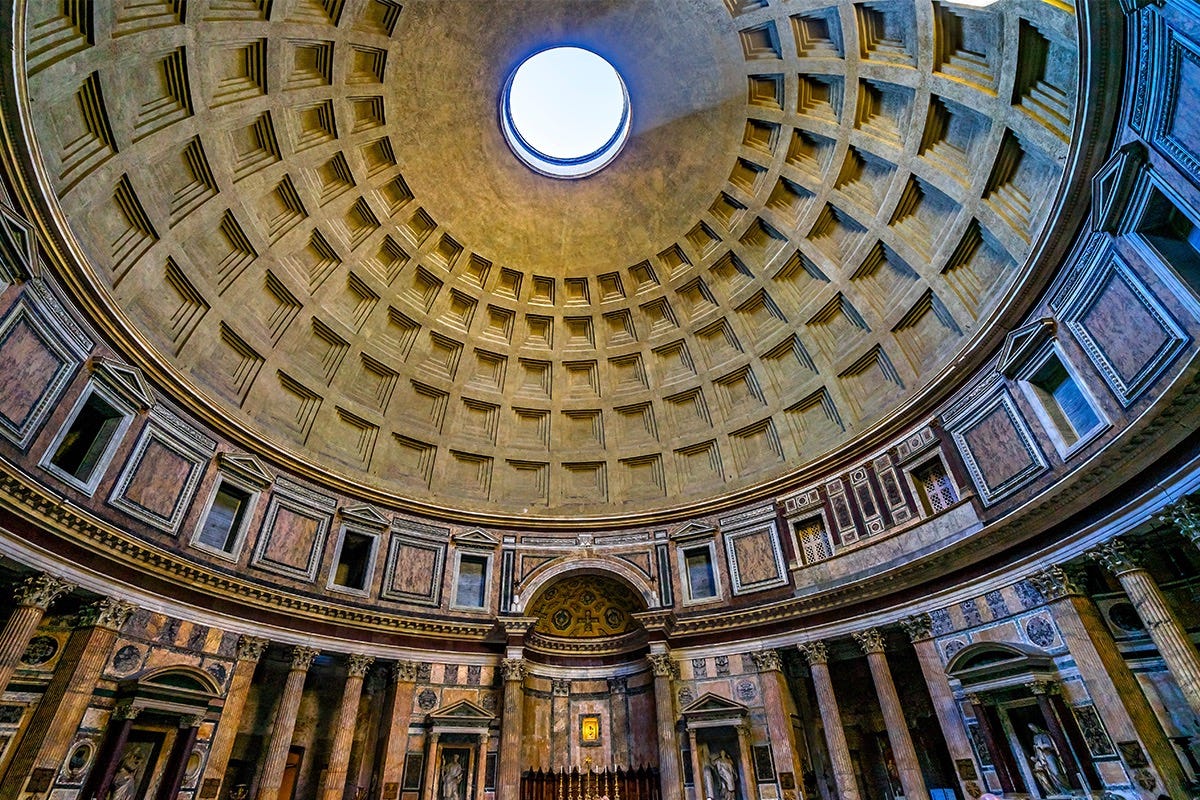
Stational Church of Santa Maria ad Martyres — The Pantheon
The Pantheon is the best-preserved building in all of ancient Rome, and perhaps the most theologically suggestive. Hadrian rebuilt it around 125 AD as a temple to all the gods of Rome — its name means precisely that: the place of all the gods. For nearly five centuries it stood as the supreme expression of Roman religious pluralism, its great dome — still the largest unreinforced concrete dome in the world — open to the sky at its oculus, the eye through which light and occasionally rain entered the sacred space. In 609, Pope Boniface IV received the building as a gift from the Emperor Phocas and consecrated it as a Christian church, dedicating it to the Virgin Mary and all the martyrs — Santa Maria ad Martyres. The bones of martyrs were brought from the catacombs and placed beneath the floor. What had been the house of all the gods became the house of the one God, and the witnesses to that God were laid to rest within its ancient walls. The oculus remains open. Light still falls through it in a single column onto whatever lies below. On Easter Friday, the station comes here, and the Gospel sends us to the Sea of Tiberias, where the Risen Lord appears at dawn on the shore, and the disciples do not recognize him until abundance makes recognition inevitable.
First Reading: Acts 4:1-12 Peter and John before the Sanhedrin — “There is no salvation through anyone else”
Responsorial Psalm: Psalm 118:1-2, 4, 22-27 “The stone rejected by the builders has become the cornerstone”
Gospel: John 21:1-14 The appearance at the Sea of Tiberias — the abundant catch — breakfast on the shore
They had gone back to fishing.
We should not read this as a failure of faith. It is simply what human beings do in the gap between promise and fulfillment — we return to what we know. The nets, the boat, the lake, the rhythm of work that requires nothing of us but our hands. Peter had said, I am going fishing, and the others had followed, because when the extraordinary recedes, the ordinary is always there to receive us.
They fish all night and catch nothing.
At dawn — John is precise about the light — a figure stands on the shore. He calls to them: “Children, have you caught anything to eat?” The question is almost domestic in its simplicity. And then: “Cast the net over the right side of the boat.” They do. The net fills with one hundred and fifty-three large fish — a number so specific that scholars have been puzzling over it for twenty centuries — and the net does not tear.
The beloved disciple recognizes him first: “It is the Lord.”
Peter, characteristically, does not wait for the boat. He throws on his outer garment and jumps into the sea.
What awaits them on the shore is almost unbearably tender. A charcoal fire. Fish already laid on it. Bread. “Come, have breakfast.” The Risen Lord of the universe is cooking breakfast on a beach for seven exhausted fishermen who have just worked all night for nothing. He takes the bread and gives it to them, and the fish likewise — and the echo of the feeding of the multitude, of the Last Supper, of Emmaus, is unmistakable. He is always known in the breaking of bread.
The oculus of the Pantheon lets light fall in a single column into the ancient dark. This morning on the Sea of Tiberias, the Risen Lord is that light — appearing at the edge of an ordinary night’s failure, making abundance from nothing, feeding those who came to him empty.
The net is full. Breakfast is ready. Come.
I have a dilemma. I can’t decide which I appreciate more; your wonderful retelling of the Gospel story, which I must have heard a hundred times, or your gift of writing style. I think I’ll choose both. Thank you.
(Not Catholic, not much of anything these days.)
This has me weeping. I am in that human place of going back to what is familiar when everything has been ripped from my life. I'm in the boat contemplating my past 12 months of chemo and radiation for pancreatic cancer. I have now had 2 clean scans and about to have my 74 birthday. The cornerstone of my activity used to be the Ignatian Spirituality Project; Ignatian retreats for those recovering from homelessness and addictions. It is not physically possible to go back to that. Your words have reminded me that I may have Jesus becconing me to something and I don't recognize it yet. I feel hope. Thank you for this reflection.